

By Bala Kalavala, Chief Architect & Technology Evangelist
Executive Overview
Across the industry, a quiet crisis is compounding. Enterprises are racing to modernize, yet the very architectural foundations meant to guide transformation are collapsing under their own weight. Documentation is stale. Institutional knowledge walks out the door. Impact analyses take weeks. And when a critical architectural decision needs to be made, it often falls to two or three irreplaceable subject-matter experts who are already stretched thin.
The emergence of agentic AI — systems capable of reasoning, planning, and acting autonomously across complex workflows — is not just another technology wave for IT to absorb. It represents a fundamental shift in how architecture is practiced, governed, and evolved. For C-suite executives, the question is no longer whether AI will reshape enterprise architecture. It is whether your organization will manage that shift deliberately or stumble through it reactively.
The Agentic Architecture Maturity Model (AAMM) offers a structured lens for answering that question. It maps where enterprises stand today, exposes the gaps silently eroding speed and resilience, and charts a path toward a future where architecture is not just documented—it is alive, intelligent, and continuously optimized.
When organizations pursue cloud migration, platform consolidation, M&A integration, or AI adoption, the speed and accuracy of architectural decision-making directly determine business outcomes. McKinsey research consistently shows that companies with strong architectural practices deliver technology transformations two to three times faster and at significantly lower cost than peers. Yet most large enterprises remain trapped in architectural practices that were designed for a slower, more predictable era.
The AAMM reframes architecture maturity not as an academic exercise but as a strategic capability — one that either accelerates or constrains every major initiative on the CEO’s agenda.
The Maturity Model: Five Levels of Architectural Capability
The AAMM uses five levels, each representing a qualitatively different state of architectural capability. The progression is not simply a matter of implementing more tooling or producing more documentation — it reflects a fundamentally different relationship between the organization and its architectural knowledge. The table below provides the structural overview; the sections that follow explore each level in depth.
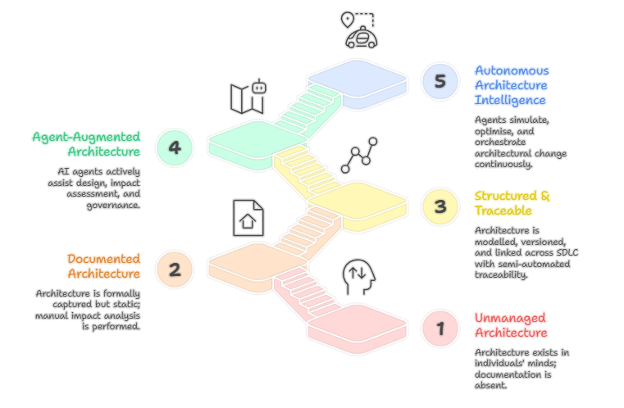
Diagram: Achieving Autonomous Architecture Intelligence
The critical insight embedded in this model is that the competitive value of architectural maturity compounds non-linearly. The step from Level 1 to Level 2 reduces individual dependency risk. The step from Level 2 to Level 3 removes the impact analysis bottleneck that silently slows every delivery team. But the step from Level 3 to Level 4 — where agents begin to augment architectural practice — changes the economics of governance entirely, enabling an organisation to maintain rigorous architectural control across a landscape of any complexity without proportionally scaling the architecture team.
Level 1. Unmanaged Architecture, architecture exists primarily as a distributed cognitive asset — held in the minds of senior engineers and architects, partially surfaced in documents and diagrams that are rarely current. There is no single authoritative source of truth. Dependency knowledge is tribal. Change decisions rely on the availability and recall of individuals who are already stretched across competing demands. Programs stall when key people are unavailable. When they leave, critical knowledge leaves with them.
Level 2. Documented Architecture introduces formal, governed documentation. Architecture is captured in wikis, collaboration platforms, and enterprise architecture tools. Standards exist. Governance processes are defined. For many organizations, reaching Level 2 represents a genuine investment and a meaningful reduction in individual dependency risk.
Level 3. Structured and Traceable Architecture is the inflection point at which architecture shifts from a record of decisions to an active input into the delivery process. Architecture is modelled in versioned, query-able platforms where relationships between applications, infrastructure components, business capabilities, and regulatory obligations are formally captured and maintained. End-to-end traceability across the software delivery lifecycle becomes possible: a proposed change to a shared integration layer can be traced forward to all affected systems and backward to the business capabilities and compliance controls it supports.
Level 4. Agent-Augmented Architecture represents a qualitative shift in what architecture can accomplish within a given capacity. AI agents are embedded into architectural practice — not as search or summarization tools, but as active participants in design review, impact assessment, and continuous governance. An agent can monitor the landscape for compliance drift and surface emerging risks before they manifest in delivery. It can generate a structured, cross-referenced impact assessment automatically when a change request is submitted. It can now retrieve relevant architectural precedents as a design decision is being made and flag where a proposed direction conflicts with established principles or introduces dependencies that would compromise resilience.
Level 5. Autonomous Architecture Intelligence represents the frontier of the model and of the technology. At this level, agents do not merely assist with individual decisions — they continuously simulate, orchestrate, and optimize the architectural landscape. Before a platform migration is approved, agents model the downstream consequences across the full dependency graph, score architectural options against business and technical constraints, identify the highest-risk transition paths, and present human architects with a decision package that includes the relevant context already assembled.
The Structural Gaps That Prevent Advancement
Understanding the maturity levels is valuable. Confronting the specific structural gaps that prevent advancement is where the real work lies. These are not primarily gaps in tooling. They are gaps in organizational design, data discipline, and the underlying philosophy of what architecture is for — and they must be resolved at the level where those decisions are made.
- Knowledge Concentration and SME Risk – The single most common barrier to advancing beyond Level 1 is the concentration of architectural knowledge in a small number of individuals. These architects carry a mental model of system interdependencies, historical decisions, and failure patterns that no documentation fully captures. When they are in high demand — which is always — the quality and speed of architectural guidance degrade. When they leave, programs built on their knowledge face an unquantified risk that typically only becomes visible at the worst possible moment. The resolution is not simply to hire more architects. It is to externalize the knowledge those individuals carry into connected, queryable models that persist independently of any individual and can be interrogated at machine speed. Every level of the AAMM above Level 1 depends on this externalization being achieved with genuine rigor.
- Documentation Drifts and the Currency Problem – Organizations at Level 2 consistently encounter the same phenomenon: investment in documentation does not close the gap between the governed model and the real landscape. Infrastructure evolves through delivery pipelines. Integrations are added without architectural review. Cloud resources are provisioned outside the governed estate. The documented architecture becomes a historical artefact rather than a live reference — and the longer it remains unclosed, the more dangerous it becomes as a basis for decision-making. Closing this gap requires a technical intervention: connecting the architecture repository to infrastructure-as-code pipelines, CI/CD toolchains, and cloud-provider APIs so that the deployed state continuously updates the governed model. This is the technical prerequisite for Level 3 and for every agentic capability that follows.
- The Impact Analysis Bottleneck – In organizations at Levels 1 and 2, the time required to produce a credible impact assessment for a proposed architectural change is one of the most reliable indicators of how much hidden cost is embedded in their delivery programs. When that analysis takes days or weeks, delivery teams make decisions without it. Technical debt accumulates not through negligence but through the rational response to a governance process that cannot keep pace with delivery velocity. The impact analysis bottleneck is not a minor inconvenience — it is a structural driver of program overruns, unplanned rework, and the kind of architectural entropy that eventually constrains every strategic option available.
- Governance That Cannot Scale – Architecture governance exists to protect the organization from the consequences of decisions made without full information. But governance processes at Levels 1 and 2 are almost invariably manual and serial — a queue that every change must pass through, serviced by a team that cannot grow fast enough to keep up with delivery demand. The predictable result is that team’s route around governance, creating the shadow IT footprint, ungoverned integrations, and unreviewed cloud expansion that characterize so much of the large enterprise landscape. The answer is not to simplify governance but to automate it — to build the Level 4 and 5 capabilities that allow rigorous governance to operate at delivery speed
- The Absent Shared Data Model – Perhaps the most foundational gap of all is rarely named directly: the absence of a unified architectural data model that connects business capability to application, infrastructure, integration, regulatory obligation, and risk in a single queryable graph. In most large enterprises, architecture exists in multiple disconnected representations — process models in one platform, application portfolios in another, infrastructure in a cloud console, integration maps in a third system. These representations share no common entity model. Without a connected architectural graph, traceability at Level 3 is structurally impossible. And without Level 3, nothing at Levels 4 or 5 can be built on solid ground.
Technology Enabling the Journey
The enabling technology for every level of the AAMM now exists in production-grade form. The following five categories are converging to make the full maturity journey achievable for organizations willing to invest deliberately rather than incrementally.
| Technology | Key Platforms | Architectural Enablement |
| Large Language Models | Claude, GPT-4, Gemini | Natural-language architecture querying; automated ADR generation; intelligent impact narration from change requests |
| Graph-Native EA Platforms | LeanIX (SAP), Ardoq | Real-time dependency traversal; automated change propagation analysis; continuous portfolio intelligence |
| Architecture-as-Code | Structurizr, Backstage, Crossplane | Version-controlled architecture artefacts; live reconciliation with deployed state; GitOps-aligned governance |
| AI Agent Frameworks | LangChain, AutoGen, CrewAI, Anthropic | Multi-step reasoning workflows; automated governance routing; composable impact assessment pipelines |
| Digital Twin Platforms | AWS Resilience Hub, Orbus iServer, LeanIX (SAP) | Continuously updated replica of live architecture; pre-change simulation; automated drift detection and alerting |
Large Language Models are the most immediately accessible enabler for organizations at Levels 1 and 2. The ability to ingest existing architecture documentation — however imperfect — and make it queryable in natural language addresses the SME concentration risk without requiring the architecture to be perfect first. An architect new to a domain can interrogate years of decision history. An impact assessment can be drafted from a change description in minutes rather than days. The friction of accessing architectural knowledge drops sufficiently that it is used in the flow of delivery rather than consulted retrospectively.
Graph-native architecture platforms provide the data substrate on which everything else depends. Platforms such as LeanIX, Ardoq, and their peer’s express architecture as a connected graph of entities — applications, capabilities, infrastructure components, regulatory obligations, integration flows, risks — rather than flat records or unstructured documents. This graph structure enables agents to traverse dependency networks, understand propagation paths, and reason with genuine accuracy about the downstream consequences of change. The graph is not an optional enhancement; it is the architectural foundation of Level 3 and above.
Architecture-as-code practices close the documentation drift gap by making the synchronization of intended and actual architecture a continuous, automated process rather than a periodic manual effort. When architecture is expressed in version-controlled code artefacts and connected to delivery pipelines, every infrastructure change that passes through those pipelines can automatically update the governed model. The drift problem does not disappear entirely, but it becomes tractable — a known and bounded gap rather than an unknown and growing one.
AI agent frameworks provide the orchestration layer needed to compose the multi-step reasoning workflows that define Level 4. A well-designed governance agent can receive a change request, traverse the architectural graph to identify affected components, retrieve the applicable compliance constraints, generate a structured impact assessment with referenced trade-offs, and route the package to the appropriate review body — without human involvement in the intermediate steps. This is not speculative: each step is achievable today with production-grade tooling. The frameworks compose them into reliable, auditable, repeatable processes.
Digital twin platforms represent the technological foundation of Level 5. By maintaining a continuously updated replica of the live enterprise architecture and exposing simulation capabilities against that replica, these platforms allow architectural changes to be rehearsed in silico before they are committed in reality. The ability to ask, ‘what is the full impact of decommissioning this platform?’ and receive a data-driven answer — across all dependent systems, regulatory obligations, and resilience characteristics — is the capability that converts autonomous architecture intelligence from an aspiration into an operational practice.
Advancing Through the Levels: A Pragmatic Sequencing of AAMM
Advancement through the AAMM is sequential in its dependencies but not necessarily uniform across the enterprise. Organizations often find value in advancing specific domains — a core platform, a regulated business line, a strategic capability cluster — ahead of the broader landscape, building both the technical foundations and the organizational evidence needed to scale.
The prerequisites for each level are consistent, however, and shortcuts around them create technical and organizational debt that eventually forces a return to basics.

Diagram: A Pragmatic Sequence of Agentic Architecture Maturity Model
At every stage, the organizational change is as important as the technical change. Architects whose role has previously been to produce documentation and review designs will need to develop new skills in agent oversight, model governance, and the interpretation of simulation outputs. The architecture function does not shrink as maturity advances — it becomes a higher-leverage capability.
Conclusion
The organizations that will lead their industries through the next decade of technological disruption will not be those with the largest IT budgets or the most ambitious transformation roadmaps. They will be those that have made architectural intelligence a genuine enterprise capability — fast enough to keep pace with change, rigorous enough to maintain control, and intelligent enough to see around corners.
The Agentic Architecture Maturity Model is not a technology framework. It is a strategic framework for answering a question that belongs in the boardroom: For most large enterprises, the candid answer today is no. The SME dependencies, documentation drift, impact analysis bottlenecks, and governance-speed tensions described in this article are not edge cases. They are the norm. And they are costing organizations measurably — in delayed programs, unplanned rework, compliance exposure, and the slow accumulation of technical debt that eventually becomes a strategic liability.
The AAMM makes the path to the advantage explicit. Moderate progress provides an impact analysis bottleneck, bringing cost efficiencies. At the same time, advancing to higher maturity levels will scale governance, delivering continuous intelligence across the enterprise, supporting faster transformation with greater confidence at lower cost, and enabling resilient architectural entropy. The AAMM offers a roadmap. The technology to travel exists today. What is required now is the executive will to treat architecture not as an IT overhead function but as the strategic capability it has always been — and to invest in advancing it with the same seriousness applied to any other source of competitive advantage.
The window to act deliberately, before architectural debt forces a reactive response, is open. It will not stay open indefinitely.
Reference:
- Gartner — Enterprise Architecture and Technology Innovation — Gartner’s research on EA maturity, AI augmentation in architecture practices, and governance frameworks: https://www.gartner.com/en/information-technology/topics/enterprise-architecture
- The Open Group — TOGAF and Agile Architecture — Authoritative framework guidance on architecture capability development and maturity: https://www.opengroup.org/togaf
- LeanIX (SAP) — Enterprise Architecture Management — Practitioner resources on architecture intelligence, application portfolio management, and AI-augmented EA: https://www.leanix.net/en/resources
- ThoughtWorks Technology Radar — Independent, practitioner-led assessments of emerging architecture practices, agentic patterns, and architecture-as-code tooling: https://www.thoughtworks.com/radar
- McKinsey Digital — Technology Architecture and Modernization — Executive-level research on the business impact of architecture maturity and the economics of technical debt: https://www.mckinsey.com/capabilities/mckinsey-digital/our-insights
The article expresses the author’s view. The author is a seasoned technologist and an enthusiastic, pragmatic digital-transformation expert at a global consulting firm. He is a sought-after keynote speaker, evangelist, and tech blogger. An angel investor and a serial entrepreneur with an impressive track record. The opinions expressed in this article are his own and do not necessarily reflect the views of his organization.