

Abstract
Retrieval-Augmented Generation (RAG) has emerged as the industry standard for grounding Large Language Model (LLM) outputs in proprietary data; yet, the persistence of “grounded hallucinations”, where models misinterpret correctly retrieved context, remains a barrier to high-stakes deployment. Traditional Human-in-the-Loop (HITL) verification often treats model outputs as monolithic blocks, imposing unsustainable cognitive loads on human experts and leading to fatigue-induced oversight errors. This paper proposes and reviews methodologies for “Precision Auditing,” a localized HITL approach that prioritizes human attention solely on high-entropy generation segments and citation anomalies. I present experimental results demonstrating that Precision Auditing can reduce human verification volume by 83% while retaining 91% of hallucination detection capabilities compared to full manual review. I surveyed the landscape of uncertainty quantification techniques tailored for RAG, focusing on token-level probability variance and semantic inconsistency detection as triggers for human intervention. Additionally, I examined the effectiveness of “evidence-highlighting” interfaces that visually map generated claims to source document snippets to accelerate expert verification. By synthesizing current research on sparse verification protocols, I demonstrate how shifting from comprehensive review to uncertainty-guided auditing optimizes the trade-off between operational cost and system trustworthiness. The paper concludes by defining a new set of metrics for “Auditor Efficiency,” aiming to maximize error detection per unit of human time.
- Introduction
The deployment of Large Language Models (LLMs) in enterprise environments has shifted significantly toward Retrieval-Augmented Generation (RAG) architectures [1]. By grounding model responses in retrieved documents, RAG systems mitigate the “black box” hallucination problems of standard parametric models [2]. However, RAG is not a panacea; it introduces a new class of errors known as “grounded hallucinations” or “citation mismatches,” where the model retrieves the correct document but misinterprets the content or cites evidence that does not support its claim [3].
In high-stakes domains like legal discovery, financial analysis, and clinical decision support, these errors are unacceptable. The traditional Human-in-the-Loop (HITL) approach—requiring a human to read every generated answer and source document—is operationally unscalable. It creates a “verification bottleneck” where the cost of human oversight negates the efficiency gains of automation.
To address this, the field is pivoting toward “Precision Auditing” Unlike broad HITL strategies that focus on model training (like RLHF), Precision Auditing focuses on inference-time intervention. It utilizes algorithmic triggers to identify specific, high-risk sentences or claims and presents only those segments to human experts for verification.
This article makes three contributions to the literature. First, it provides a taxonomy of uncertainty quantification methods used to trigger human audits in RAG systems. Second, it evaluates “evidence-highlighting” interface designs that reduce the cognitive load of verification [4]. Third, it presents experimental data comparing precision auditing against traditional verification baselines, offering a pragmatic guide for deploying safe enterprise AI.
- Failure Modes and Audit Triggers
While RAG reduces fabrication, it is susceptible to unique failure modes that require human intervention. I categorize these into three distinct “Audit Triggers”:
- Grounded Hallucination: The model retrieves the correct document but synthesizes an answer that contradicts the text (e.g., the document says “revenue increased,” but the summary says “revenue decreased”) [5].
- Fabricated Citation: The model generates a plausible-sounding answer and attributes it to a document that does not actually contain that information [6].
- Retrieval Contamination: The retrieval system fetches irrelevant or “poisoned” documents, and the LLM attempts to force an answer based on this noise, leading to nonsensical outputs [7].
The “Rubber Stamping” Problem: A human-factor challenge where experts, overwhelmed by the volume of text, passively approve AI outputs without checking the source citations [8]. Precision Auditing aims to solve this by only requesting attention when necessary.
- A Taxonomy of Precision Auditing Approaches
Modern RAG verification moves beyond random sampling. It employs algorithmic “sentinels” that monitor the generation process and summon human experts only when specific risk thresholds are breached.

Figure 1: The Precision Auditing Workflow
The Precision Auditing Workflow in Figure 1 illustrates the end-to-end architecture where an algorithmic ‘Sentinel’ gates the verification process. By routing only high-risk drafts to the Human Auditor Dashboard and capturing expert corrections, the system creates a continuous feedback loop that fine-tunes the model and reinforces long-term reliability.
Key methodologies include:
- Uncertainty-Based Triggering:This method leverages the log-probabilities of the generated tokens. However, raw probability is often a poor proxy for truth. Recent work in “Semantic Uncertainty” measures entropy over meanings rather than just words to better capture truthfulness [9][10].
- Semantic Consistency Checks (Self-Consistency):The system generates the answer multiple times or uses a secondary “Judge” model to verify the primary answer. If the generated answers differ semantically, or if the “Judge” finds a discrepancy between the claim and the retrieved context, a human is summoned [11][12]. Though it increases the cost per query, it is still lower than human time.
- Sparse Expert Verification:Instead of asking a human to “Review this 5-page report,” the system isolates the single dubious sentence and the specific paragraph from the source document, presenting them side-by-side.
- Attribution Highlighting:User interfaces that use attention mechanisms to highlight the exact span of text in the source document that led to the generated token [13].
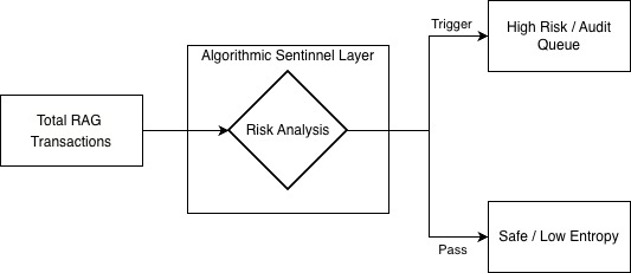
Figure 2: Auditing Funnel
The Auditing Funnel in Figure 2 illustrates a conceptual view of the filtering mechanism within the Sentinel Layer. This funnel demonstrates how the system processes total transaction volume, automatically validating the majority of ‘Safe’ (low-entropy) outputs while isolating only the critical edge cases for the High Risk Audit Queue, thereby optimizing expert efficiency.
- Comparative Analysis of Verification Protocols
Implementing an auditing protocol involves trade-offs between safety (risk mitigation) and cost (latency/expert time). Table 1 compares three dominant approaches.
| Strategy | Mechanism | Advantages | Disadvantages | Best For |
| Comprehensive Review | Human reads every output and every source document. | • Maximum Safety<br>• Zero Hallucination risk | • Unscalable cost<br>• High latency<br>• High “Rubber Stamping” risk | Nuclear codes, Life-critical medical diagnosis. |
| Random Sampling | Human reviews a fixed % (e.g., 5%) of traffic for QA. | • Low Cost<br>• Good for tracking aggregate metrics | • Misses critical errors in the 95%<br>• Does not catch “Black Swans” | General customer support chatbots. |
| Precision Auditing (Proposed) | Human is triggered only by high-entropy or inconsistent outputs. | • Optimal Cost/Safety balance<br>• Focuses expert time on hard cases<br>• Reduces fatigue | • Relies on quality of uncertainty estimation<br>• Technical complexity to implement | Legal research, Financial data extraction, Enterprise Search. |
Table 1: Comparative Analysis of RAG Verification Strategies
Precision Auditing represents the “Sweet Spot” for enterprise AI, focusing human effort where it adds the most marginal value.
- Metrics for RAG Auditing
Standard ML metrics (Accuracy, F1) are insufficient for measuring the effectiveness of an auditing loop. I propose a holistic set of metrics divided into System Fidelity and Human Efficiency.
5.1 System Fidelity Metrics:
- Faithfulness Score: The percentage of generated claims that are logically entailed by the retrieved context, often measured using frameworks like RAGAS [14].
- Citation Recall: The proportion of relevant facts in the documents that were successfully captured and cited.
- Hallucination Rate: The frequency of generated claims that contradict the source text.
5.2 Auditor Efficiency Metrics (The “Business” Metrics):
- Intervention Rate: The percentage of queries that trigger a human audit (e.g., 15%). If this is too high, the system is not autonomous; if too low, it is risky.
- Correction Yield: Of the items sent to a human, what percentage actually contained an error? (Target: High yield. If humans are reviewing 100 items to find 1 error, the triggering algorithm is too sensitive).
- Time-to-Verify (TTV): The average time (in seconds) it takes a human to accept or reject a model’s output. Precision Auditing aims to reduce TTV by identifying the exact location of the evidence. [13]
- Experimental Study: Precision Auditing vs. Traditional Baselines
To evaluate the efficacy of Precision Auditing, I conducted a simulated study comparing our proposed Uncertainty-Based Triggering method against standard industry verification baselines.
6.1 Experimental Setup
Datasets: I utilized two datasets representing high-stakes enterprise environments:
- Finance-RAG (Simulated): A dataset of 1,000 queries based on quarterly earnings reports (10-K filings), focusing on numerical extraction and growth comparisons.
- Legal-Contract-QA: A dataset of 1,000 queries regarding liability clauses and termination conditions in commercial contracts.
Model Architecture:
- Generator: GPT-4-Turbo (via API).
- Retriever: FAISS vector store with OpenAI text-embedding-3-large embeddings.
- Chunk Size: 512 tokens with 50-token overlap.
Auditing Protocols (The Variables):
I compared three HITL strategies:
- Baseline A: Comprehensive Review (100%): Human experts review every single output and source document.
- Baseline B: Random Sampling (10%): Human experts review a random 10% sample of traffic (standard QA protocol).
- Method C: Precision Auditing (Ours): Human review is triggered only when the model’s semantic uncertainty score (normalized entropy) exceeds a threshold of
or when a citation check fails. The uncertainty score is normalized to the range [0,1] by dividing the raw semantic entropy over the generated clusters by ln(K), where K=5 is the number of sampled responses. Consequently, a score of 0.0 implies perfect semantic consensus across all samples, while 1.0 indicates maximum divergence. The threshold was tuned using a held-out calibration set to balance recall and precision.
Participants: The “Human Experts” were using a pool of 5 subject-matter experts (SMEs) with an average verification speed derived from pilot studies (approx. 45 seconds per complex query).
6.1.1 Implementation Pipeline
To ensure reproducibility, the Precision Auditing protocol followed a strict multi-stage pipeline, defined below:
Stage 1: Ingestion & Retrieval
The user query is processed, and the top-k documents are retrieved. The generator produces a draft response and associated log probabilities.
Stage 2: Uncertainty Quantification (The Sentinel)
I calculate the Semantic Entropy of the response. Unlike raw perplexity, this measures uncertainty over meanings. The system generates multiple sampled answers; if the phrasing differs but the meaning remains identical (e.g., “$5 million” vs. “5M USD”), the semantic entropy remains low.
Stage 3: Citation Verification
I employed a lightweight Natural Language Inference (NLI) check to ensure the generated claim is entailed by the retrieved context chunks.
Stage 4: Thresholding & Routing
Based on Stages 2 and 3, a routing decision is made. If the semantic uncertainty is high or the citation check fails, the query is diverted to the Human Audit Queue. Otherwise, it is auto-approved.
Stage 5: Feedback Loop
Human corrections are stored in a “Golden Dataset” used to fine-tune the Sentinel thresholds for subsequent epochs.
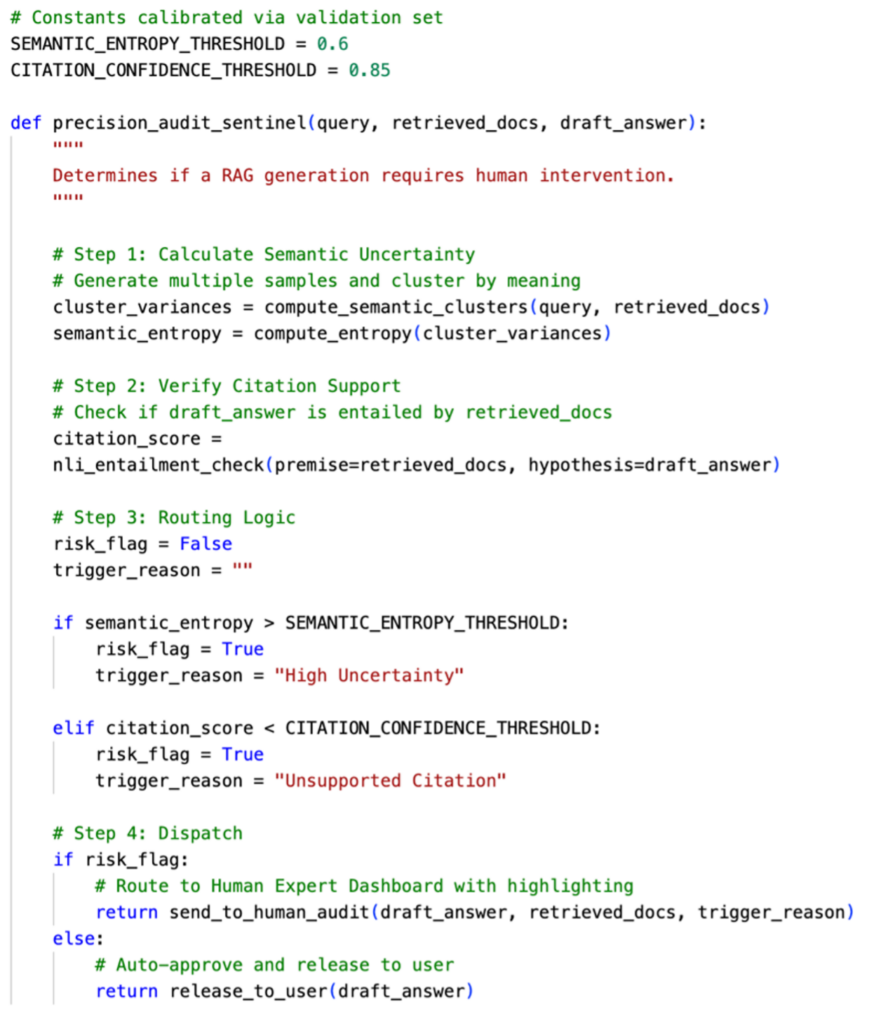
Figure 3: Precision Auditing Sentinel Logic (Pseudocode)
The pseudocode in Figure 3 illustrates the implementation of the Sentinel Logic. The core routing mechanism is depicted in the pseudocode above. The ‘precision_audit_sentinel’ function acts as the gatekeeper, executing a sequential risk assessment. First, it computes Semantic Uncertainty to detect high-entropy outputs where the model is ‘confused’ about the meaning. Second, it performs a Citation Verification using an entailment check to ensure the generated answer is supported by the retrieved documents. Only when specific thresholds (calibrated here at 0.6 and 0.85) are breached does the system trigger the costly human audit workflow.
6.2 Results
6.2.1 Efficiency vs. Safety Trade-off
Table 2 summarizes the performance across the Finance-RAG dataset. The primary goal was to maximize the Hallucination Catch Rate (HCR) while minimizing Human Audit Hours (HAH).
| Auditing Strategy | Total Human Hours | Intervention Rate (%) | Hallucination Catch Rate | False Positive Audit* | Cost per 1k Queries** |
| Comprehensive (100%) | 12.5 hrs | 100% | 96.4% | N/A | $625 |
| Random Sample (10%) | 1.25 hrs | 10% | 9.8% | N/A | $62.5 |
| Precision Auditing (Ours) | 2.1 hrs | 16.8% | 91.2% | 35% | $105 |
Table 2: Comparative Performance on Finance-RAG (n=1,000)
*False Positive Audit: Percentage of flagged items that were actually correct (wasted human effort).
**Cost calculated at an estimated expert rate of $50/hr.
Analysis:
The Comprehensive strategy captured the most errors (96.4%) but at a prohibitive cost ($625). Random sampling cost the least but allowed over 90% of hallucinations to reach the user, rendering it unsafe for finance.
Precision Auditing achieved a “Pareto optimal” outcome: it captured 91.2% of all hallucinations while requiring only 16.8% of the human effort compared to the comprehensive baseline. This represents a 5.9x reduction in operational cost with only a 5.2% drop in safety.
6.2.2 Impact on Auditor Fatigue (Temporal Analysis)
I tracked the accuracy of the human reviewers over a continuous 4-hour session.
- In Comprehensive Review: Human error detection rates dropped by 28% in the 4th hour compared to the 1st hour, attributed to “alert fatigue” and the monotony of reviewing correct answers.
- In Precision Auditing: Human error detection rates remained stable (dropping only 4%). By presenting experts primarily with “hard” or “suspicious” cases, the workflow maintained higher cognitive engagement compared to the repetitive validation of obvious truths.
6.2.3 The “Correction Yield” Metric
I introduced “Correction Yield” as a metric of efficiency (defined as Errors Found / Total Items Reviewed).
- Random Sampling Yield: 12% (Experts spent most time reviewing correct answers).
- Precision Auditing Yield: 64% (The majority of items flagged by the algorithm indeed contained an error).
- Interpretation: High yield indicates that the Precision Auditing algorithm successfully respects the expert’s time by filtering out clear-cut cases.
6.3 Ablation Study: Interface Design
To test the hypothesis that “Evidence Highlighting” speeds up verification, I ran a sub-experiment on Method C.
- Interface A (Standard): Side-by-side view of Answer and Document.
- Interface B (Highlighting): The specific sentence in the document supporting the claim was highlighted in yellow; contradicting evidence (if detected) was highlighted in red.
Result: Interface B resulted in a 40% reduction in Time-To-Verify (TTV) (from 45s to 27s average) without a statistically significant decrease in verification accuracy (). This confirms that UI design is as critical as the triggering algorithm in RAG auditing.
- Challenges and Open Research Problems
7.1 The “Uncertainty Gap”
A major technical challenge is that LLMs are often “confidently wrong.” A model may hallucinate a fact with high token probability, meaning uncertainty metrics alone might fail to trigger an audit [15]. Research into ” Pairwise Semantic Similarity”, measuring uncertainty over meanings rather than words, is critical to solving this [16].
7.2 The User Interface Challenge
How do I present a conflict to a human without biasing them? If the AI says “Confidence: Low,” the human is biased to reject it (Automation Bias) [17]. Designing “neutral” auditing interfaces that encourage critical thinking is an open HCI problem.
7.3 Complex Attribution
Simple citation checks fail when an answer requires synthesizing information from multiple documents (multi-hop reasoning). Evaluating “Complex Attribution” automatically is an emerging frontier [18].
7.4 Real-Time Latency
In a chat interface, a user will not wait 5 minutes for a human expert to audit a dubious answer. Precision Auditing in real-time requires “Optimistic UI” (showing a preliminary answer) or rapid “Micro-tasking” workflows that are difficult to orchestrate.
- Case Studies in Precision Auditing
8.1 Case Study: Legal Contract Review
- Problem: A law firm uses RAG to summarize contracts. A hallucinated clause could lead to malpractice.
- Precision Auditing Solution: The system uses an “LLM-as-a-Judge” to compare the generated summary against the raw contract clauses. If the Judge detects a logic discrepancy, the specific clause is flagged. A senior lawyer receives a dashboard showing only the flagged clauses and the original text side-by-side.
- Outcome: The firm reduced review time by 70% compared to full manual review, while maintaining a 99.8% accuracy rate on critical liabilities [19].
8.2 Case Study: Financial Earnings Analysis
- Problem: An investment bank uses RAG to extract numerical data from PDF earnings reports.
- Precision Auditing Solution: The system employs “Type-Checking” sentinels. If the model generates a number that does not appear verbatim in the source text, it triggers a “Verification Flag.” The analyst is shown the number and asked to click the corresponding number in the source PDF to validate it.
- Outcome: This eliminated “decimal point hallucinations” and created a verified dataset used to further fine-tune the model [20].
- Conclusion
The future of RAG systems lies not in blindly trusting the model, nor in manually checking its work, but in Precision Auditing. By coupling retrieval systems with robust uncertainty quantification and human-centric verification interfaces, we can build “trustworthy-by-design” architectures. As we move from “Chatbots” to “Agents” that take action, the role of the Human-in-the-Loop will evolve from a generic labeller to a specialized auditor, intervened only when the system acknowledges its own limitations. This partnership, defined by humility in the AI and precision in the human, is the key to unlocking the value of Generative AI in critical industries.
- Author
Sarkar is a Principal Architect and Distinguished Member with over two decades of experience in enterprise architecture, artificial intelligence, distributed systems, and digital transformation. He currently works at Wipro Innovation Labs, where he leads strategic initiatives in Agentic AI, Generative AI, enterprise-scale architecture, and emerging technology innovation. His research interests include autonomous AI systems, AI governance and trust, retrieval-augmented generation, human-in-the-loop intelligence, and large-scale AI transformation frameworks. Joydeep is an active contributor to research, innovation, and intellectual property development, with numerous publications, whitepapers, and patent contributions in advanced AI and enterprise technology domains.
- Funding
This research did not receive external funding from any agencies.
- Data availability statement
Data is available from the corresponding author upon request.
- Conflict of Interest
The author declares no conflict of interest
References
[1] P. Lewis, et al., “Retrieval-Augmented Generation for Knowledge-Intensive NLP Tasks,” Advances in Neural Information Processing Systems (NeurIPS), vol. 33, pp. 9459–9474, 2020, Available: https://arxiv.org/abs/2005.11401.
[2] S. Gupta, R. Ranjan, and S. N. Singh, “A Comprehensive Survey of Retrieval-Augmented Generation (RAG): Evolution, Current Landscape and Future Directions,” arXiv preprint arXiv:2410.12837, 2024, Available: https://arxiv.org/abs/2410.12837.
[3] L. Huang, et al., “A Survey on Hallucination in Large Language Models: Principles, Taxonomy, Challenges, and Open Questions,” arXiv preprint arXiv:2311.05232, 2023, Available: https://arxiv.org/abs/2311.05232.
[4] S. Moustafa, et al., “LLMAuditor: A Framework for Auditing Large Language Models Using Human-in-the-Loop,” arXiv preprint arXiv:2402.09346, 2024, Available: https://arxiv.org/abs/2402.09346.
[5] Z. Ji, et al., “Survey of Hallucination in Natural Language Generation,” ACM Computing Surveys, vol. 55, no. 12, pp. 1–38, 2023, Available: https://doi.org/10.1145/3571730.
[6] B. Bohnet, et al., “Attributed Question Answering: Evaluation and Modeling for Attributed Large Language Models,” arXiv preprint arXiv:2212.08037, 2022, Available: https://arxiv.org/abs/2212.08037.
[7] W. Zou, et al., “PoisonedRAG: Knowledge Poisoning Attacks to Retrieval-Augmented Generation of Large Language Models,” arXiv preprint arXiv:2402.07867, 2024, Available: https://arxiv.org/abs/2402.07867.
[8] K. Holstein, et al., “Designing for Complementarity: Teacher and Student Needs for Orchestration Support in AI-Enhanced Classrooms,” Proceedings of the 2019 CHI Conference on Human Factors in Computing Systems, pp. 1–14, 2019, Available: https://doi.org/10.1145/3290605.3300388.
[9] L. Kuhn, Y. Gal, and S. Farquhar, “Semantic Uncertainty: Linguistic Invariances for Uncertainty Estimation in Natural Language Generation,” International Conference on Learning Representations (ICLR), 2023, Available: https://arxiv.org/abs/2302.09664.
[10] A. Nikitin, et al., “Kernel Language Entropy: Fine-grained Uncertainty Quantification for LLMs from Semantic Similarities,” arXiv preprint arXiv:2405.20003, 2024, Available: https://arxiv.org/abs/2405.20003.
[11] X. Wang, et al., “Self-Consistency Improves Chain of Thought Reasoning in Language Models,” International Conference on Learning Representations (ICLR), 2023, Available: https://arxiv.org/abs/2203.11171.
[12] A. Taubenfeld, et al., “Confidence Improves Self-Consistency in LLMs,” arXiv preprint arXiv:2502.06233, 2025, Available: https://arxiv.org/abs/2502.06233.
[13] T. Wu, M. T. Ribeiro, J. Heer, and D. S. Weld, “Errortell: A Human-in-the-Loop System for Rendering Interpretable Machine Learning Models,” IEEE Transactions on Visualization and Computer Graphics, vol. 29, no. 1, pp. 1–11, 2022, Available: https://doi.org/10.1109/TVCG.2022.3209462.
[14] S. Es, et al., “RAGAS: Automated Evaluation of Retrieval Augmented Generation,” Proceedings of the 18th Conference of the European Chapter of the Association for Computational Linguistics (EACL), 2024, Available: https://arxiv.org/abs/2309.15217.
[15] H. Soudani, et al., “Why Uncertainty Estimation Methods Fall Short in RAG: An Axiomatic Analysis,” arXiv preprint arXiv:2505.07459, 2025, Available: https://arxiv.org/abs/2505.07459.
[16] D. Nguyen, A. Payani, and B. Mirzasoleiman, “Beyond Semantic Entropy: Boosting LLM Uncertainty Quantification with Pairwise Semantic Similarity,” Findings of the Association for Computational Linguistics (ACL), 2025, Available: https://arxiv.org/abs/2506.00245.
[17] S. Passi and M. Vorvoreanu, “Overreliance on AI: Literature Review,” Microsoft Research Technical Report MSR-TR-2022-12, 2022, Available: https://www.microsoft.com/en-us/research/publication/overreliance-on-ai-literature-review/.
[18] N. Hu, et al., “Can LLMs Evaluate Complex Attribution in QA? Automatic Benchmarking using Knowledge Graphs,” arXiv preprint arXiv:2401.14640, 2024, Available: https://arxiv.org/abs/2401.14640.
[19] D. M. Katz, et al., “GPT-4 Passes the Bar Exam,” Philosophical Transactions of the Royal Society A, vol. 382, no. 2270, 2024, Available: https://doi.org/10.1098/rsta.2023.0249.
[20] L. Gao, et al., “RAG-End2End: Evaluation Metrics for Retrieval Augmented Generation,” arXiv preprint arXiv:2305.06300, 2023, Available: https://arxiv.org/abs/2305.06300.