

By Prabhakar V
Enterprises loudly claim they are “data-driven.” They invest in AI dashboards, cloud warehouses, data lakes, and automation.
Yet the most critical truth remains ignored:
Most Data Architects operate far downstream—long after data is created, distorted, or lost.
Their role is confined to modelling, ETL, and analytics, while the real decisions that determine data quality happen far upstream. This is why organizations keep fighting the same data fires endlessly.
The 10% Problem — The Most Dangerous Gap in Data
Here’s the uncomfortable reality:
Most Data Architects understand maybe 10% of the source systems that actually generate enterprise data.
They know the warehouse. They know the dashboards.
But they often don’t understand:
- How fields are validated at entry
- How IDs and timestamps are created
- How exceptions behave in real workflows
- How states and transitions are implemented
- How reference data is applied in transactions
- How upstream integration failures cascade
A Data Architect who doesn’t understand source systems is designing based on filtered illusions, not operational truth.
You cannot architect enterprise accuracy if you don’t understand where accuracy begins.
And that makes the 10% problem a major No-Go.
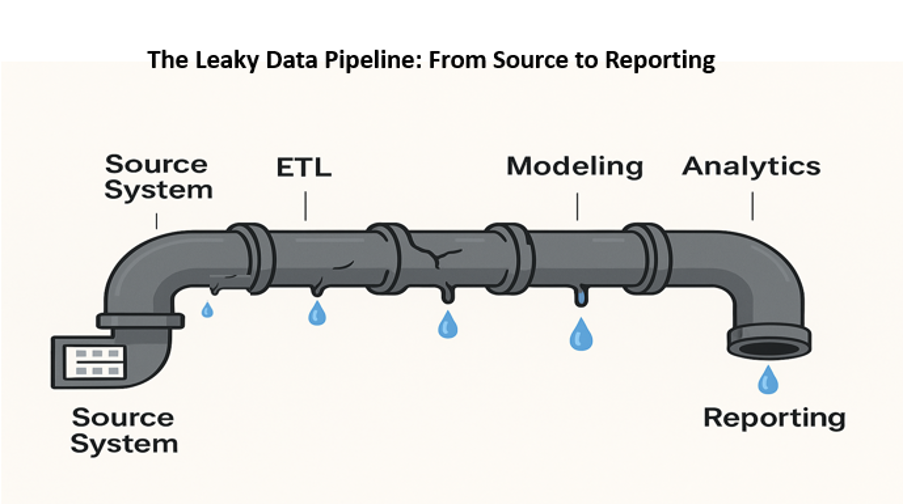
Data Design Starts at the First Click — Not the Final Dashboard
Every business process—onboarding, fulfilment, claims, finance, service is a data creation engine.
Yet most are still architected almost entirely by:
- Solution Architects
- Application teams
- Business owners
The Data Architect joins later, usually after problems emerge.
By then, the system is already producing:
- Missing fields
- Broken identifiers
- Ambiguous workflow states
- Inconsistent timestamps
- Unmeasurable KPIs
- Manual patchwork to “fix the data”
These are not BI issues.
They are upstream design failures.
Data architecture must begin at the first click, not at the final dashboard.
Business Owns the KPIs — But the Data Architect Ensures They’re Measurable
Let’s clarify:
Business defines the process.
Business defines the KPIs.
But KPIs are meaningless unless the process captures the data required to measure them—completely and automatically.
This is where Data Architects and Solution Architects must co-create.
Together, they ensure:
- KPI-critical fields are captured
- IDs and timestamps follow standards
- Events reflect real process transitions
- Exceptions and retries are always logged
- Metadata supports traceability
- Data granularity matches measurement logic
- No manual “data fixing” is required later
Automation means zero manual data.
If humans must fill gaps, the architecture has failed.
Measurability must be designed from day one—not retrofitted.
Upstream Co-Creation: The Only Reliable Model
When Data Architects work upstream with Solution Architects:
- Processes become self-measuring
- Data becomes complete by default
- KPIs reflect operational truth
- ETL becomes simpler and lighter
- Reconciliation virtually disappears
- Dashboards stop contradicting systems
Co-creation isn’t a luxury.
It is the foundation of accurate, trustworthy data.
Architect Data Flow — Not Just Data Models
A Data Architect must design how data moves, not just how it is modelled.
This includes:
- Upstream → midstream → downstream flow
- Integration contracts
- Transformations and timing
- SLA and latency behaviour
- Dependencies and possible bottlenecks
- Duplication, drift, or divergence
Most failures happen at system boundaries.
Without complete flow visibility, architecture becomes guesswork.
Deadlocks Aren’t Surprises — They’re Design Flaws
Batch collisions, queue backlogs, partial loads, API mismatches—these aren’t random.
They’re architectural failures.
A modern Data Architect designs resilience through:
- Idempotent ingestion
- Replay-safe patterns
- Versioned schemas
- CDC for reliable change capture
- Buffering/backpressure strategies
- Clear SLAs between systems
Resilience is engineered, not rescued.
Data Completeness: The Non-Negotiable Baseline
Completeness is the root of trust.
It must be designed into the process—not patched in ETL.
A Data Architect ensures:
- Mandatory fields are always present
- State transitions are fully recorded
- Time logic is consistent
- Exceptions never disappear
- Metadata supports auditability
- Reference data stays aligned
Incomplete data creates chaos.
Complete data creates confidence.
Lifecycle Architecture: Hot, Warm, Cold — and Retire the Rest
Most organizations keep everything in expensive storage.
A Data Architect enforces data lifecycle:
- Hot — frequently queried
- Warm — recent historical
- Cold — rarely accessed
- Archived — long-term compliance
Lifecycle thinking improves performance and controls cost.
Why Data Architects Stay Downstream
If upstream design solves so much, why isn’t it standard?
Because the barriers are cultural:
- Inertia: “We’ve always done it this way.”
- Leadership blind spots: Assuming data problems belong to BI.
- Territory protection: Solution Architects fear delays.
- Role minimization: Data Architects accept a warehouse-only identity.
They’re not downstream due to lack of value—
they’re downstream because the organization hasn’t recognized the cost.
Conclusion: Expand the Role or Accept Endless Data Pain
A Data Architect must:
- Understand source systems deeply
- Co-create with Solution Architects
- Drive KPI-first design
- Ensure complete data capture
- Own end-to-end data flow
- Prevent deadlocks
- Govern lifecycle and archival
A Data Architect is not a schema designer.
They are the architect of enterprise truth.
And it’s time their role finally reflected that.
