

By Holt Hackney
James Wilt is a voraciously curious CTO, Distinguished Chief Architect & Engineering Advocate dedicated to advancing the profession of Architecture.
With over 40 years of experience spanning aerospace, operating systems, cloud platforms, and AI across healthcare and financial services, he serves as a board-certified Distinguished Chief Architect at WVE.
For three decades, James has shaped the global architecture community through the Microsoft Architecture Advisory Board (MAAB), the Microsoft Certified Architect (MCA) program, as an Open Group Digital Practitioner, and through Iasa’s CITA-P/D and BTABoK.
Now active in the Chief Architect Forum (CAF), he focuses on applying bleeding-edge technologies, particularly Generative AI, to accelerate software modernization and digital transformation with disciplined, enterprise-ready execution.
To learn more about Wilt’s career and more specifically his work with CAF, we recently conducted the following interview, below:
You’ve built a career as a chief architect. What were the pivotal moments or decisions that most shaped your path into enterprise architecture leadership?
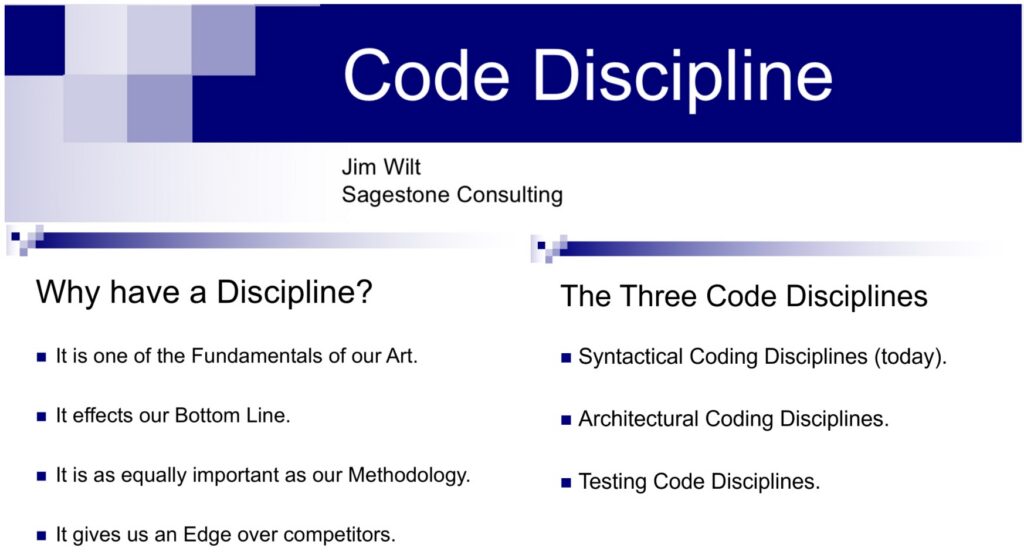
One of the defining tenets of architecture is the ability to rapidly adapt to emerging technologies. The dot-com boom introduced a wave of new tools and platforms, accelerating application development at an unprecedented pace. Books like Writing Solid Code by Steve Maguire focused primarily on coding techniques rather than the broader software lifecycle. In 1999, I created an internal course called Code Discipline designed to address the full Software Development Life Cycle (SDLC). That effort marked my first intentional step toward practicing architecture as a distinct professional discipline rather than simply an extension of programming.
This opened the door to years of collaboration with pioneering architects in the MAAB, participation in the inaugural MCA certifications that later evolved into Iasa’s CITA, and formal architect education through Iasa’s Architecture Foundation courses. Engaging across all these fronts not only accelerated my own growth but allowed me to help shape and advance the profession itself.
How has the role of a chief architect changed over the past decade, particularly with the rise of AI, cloud-native systems, and platform-based business models?
While patterns and practices continually evolve, the core principles of architecture remain steady. Architects play a critical role in integrating emerging technologies—not because they predict the future, but because they apply disciplined patterns that enable learning alongside adoption. By engaging the bleeding edge early, they generate insight and position the enterprise to make informed, forward-looking decisions ahead of the curve as technologies mature.
An emerging technology is an opportunity, never a threat.
What initially drew you to the Chief Architect Forum, and how has your involvement influenced your thinking or approach to architecture?
The greatest advances in architecture never happen in a vacuum. They emerge from rigorous debate where truth is separated from hype. A group of architects is often called an “Argument of Architects” for good reason: we are passionate, and once the truth surfaces, we unite behind it. I’ve seen complex problems resolved quickly when the focus stays on discovering truth, not personal ego.
The CAF is my sounding board, course correction, and sanity check. Its collective experience is extraordinary. We share ideas early, still in the ideation phase, to challenge and refine them. While similar collaboration exists within enterprises, the diversity and depth of perspective in the CAF provides insights simply unavailable inside any single organization.
From your perspective, what makes CAF uniquely valuable compared to other professional networks for senior architects?
It begins with the “C.”
Chief Architects are, first and foremost, architects. But unlike many others in the discipline, they also operate inside the complexity of the C-Suite—navigating personalities, egos, politics, budget pressures, shareholder expectations, and shifting strategic directives. At this level, architecture is not just about patterns and platforms, it’s also about influence, alignment, and stewardship.
 A Chief Architect must translate enterprise strategy into technical direction while simultaneously shielding engineering and architecture teams from unintended friction created by executive decisions. Many obstacles imposed on delivery are not malicious, they are simply byproducts of competing priorities at the top. Clearing those obstacles, without eroding executive trust, is part of the craft.
Connection at this level is paramount to ensure architects across the enterprise are empowered, their recommendations carry weight, and their guidance is not seen as resistance, but as stewardship of long-term value.
Many observers are eager to offer opinions on how the C-Suite should behave. Far fewer understand how it actually behaves. That distinction matters. CAF members bring hard-earned, lived experience from operating at that altitude. They understand the dynamics, trade-offs, and pressures that shape executive decision-making.
That insight is rare. And it is golden.
What trends are you tracking in 2026?
AI will empower every discipline within the enterprise driving operational efficiencies and enabling meaningful breakthroughs. The architect’s role is to debunk the hype and promote areas of value.
CAF members are already leading in this space. You may not see splashy headlines announcing their revelations, but you will see them on keynote stages alongside industry leaders, sharing how emerging technologies are being applied pragmatically to deliver measurable outcomes and value.
Is that coincidence or correlation?
For aspiring architects aiming to reach the chief architect level, what skills or experiences should they prioritize, and how can communities like CAF accelerate their development?
Deliver. Deliver. Deliver.
The greatest measure of an architect’s value is helping others achieve their objectives through sound architectural execution and especially by example.
Invest in yourself. Vendor certifications sharpen execution within specific platforms. Industry architecture certifications, however, deepen and broaden your mastery across domains that transcend any single technology: Business Technology Strategy, Human Dynamics, Design, Quality Attributes, and the IT Environment.
Mastery in these disciplines is what truly enables an architect to move forward with confidence and durability!