

Software engineering is entering a phase where artificial intelligence is no longer limited to code suggestions or test generation. AI agents are beginning to participate in the broader software delivery lifecycle as active collaborators that can analyze requirements, inspect design choices, validate architectural decisions, review source code, and recommend improvements before defects move downstream. In an AI-infused SDLC, these agents act as intelligent review partners. They do not replace architects, designers, developers, or reviewers, but they help them work with better context, stronger consistency, and faster feedback loops.
The real opportunity is not simply to ask a model to “review this document” or “check this code.” Such generic prompts create inconsistent outcomes. A more mature approach is to develop reusable boilerplate skills and specialized agents for design review, architecture review, and code review. These skills can be packaged into repeatable archetypes, governed through checklists, and orchestrated through a multi-agent review model. With this structure, enterprises can move from informal AI assistance to an engineering-grade quality assurance mechanism embedded into delivery pipelines.
1. Why Review Needs to Change in an AI-Infused SDLC
Traditional review practices were designed for a development model where humans produced most artifacts sequentially. Requirements were reviewed by business analysts, solution designs by architects, code by developers, and deployments by operations teams. AI-assisted development changes this rhythm. Engineers can now generate large volumes of code, documentation, test cases, migration scripts, and configuration changes in a much shorter time. While this improves speed, it also creates a new form of verification pressure. The organization must now review more artifacts, with more dependencies, at a faster pace.
This is where agentic review becomes valuable. Research and industry commentary on agentic software engineering increasingly describe the shift from simple code completion to delegated execution under human supervision, where agents operate across repositories, features, and lifecycle activities rather than isolated lines of code. The implication is clear: if agents can help create software artifacts, they must also help validate them. Review should therefore become continuous, checklist-driven, traceable, and context-aware.
2. Boilerplate Skills for Review Agents
A skill is a reusable unit of capability that an agent can invoke to perform a focused review activity. Instead of building one large agent that tries to understand everything, it is better to create small, well-scoped skills that can be composed into larger review workflows. Each skill should have a defined purpose, input contract, checklist, evidence model, output structure, confidence score, and escalation rule.
For design review, boilerplate skills may include requirement traceability analysis, user journey validation, API contract inspection, data model consistency review, non-functional requirement coverage, privacy review, and user experience risk assessment. For architecture review, skills may include cloud landing zone fitment, resilience analysis, integration pattern validation, security zoning, scalability review, observability assessment, cost and FinOps evaluation, and compliance alignment. For code review, skills may include style validation, dependency analysis, secure coding review, test adequacy assessment, performance hotspot detection, backward compatibility checking, and maintainability scoring.
The important design principle is that each skill must be explicit. A “security review skill” should not vaguely search for security issues. It should know which controls to apply, such as input validation, authentication, authorization, secret handling, dependency provenance, logging, data masking, and secure error handling. Similarly, an “architecture review skill” should understand the target reference architecture, approved technology standards, integration constraints, and deployment model before issuing recommendations.
3. Specialized Agents for Design, Architecture, and Code Review
Once boilerplate skills are available, they can be composed into agents. A Design Review Agent examines whether the solution intent is clear, complete, and testable. It checks whether business requirements are mapped to functional specifications, whether assumptions are documented, whether edge cases are handled, and whether user journeys are consistent with the expected experience. In a product development context, this agent can also flag gaps between product epics, acceptance criteria, and design artifacts.
An Architecture Review Agent evaluates whether the proposed solution is structurally sound. It reviews component boundaries, integration flows, deployment topology, platform services, security patterns, data movement, resiliency choices, performance considerations, and operational readiness. It can compare the proposed architecture against enterprise reference models, cloud-native principles, or domain-specific architecture standards. For example, in a cloud migration program, this agent can inspect whether an application is suitable for lift-and-shift, re-platforming, refactoring, or rebuilding.
A Code Review Agent inspects source code, pull requests, test coverage, dependency files, configuration changes, infrastructure scripts, and build pipeline updates. It should not compete with deterministic tools such as static analyzers, linters, software composition analysis, and security scanners. Instead, it should work with them. Deterministic tools identify known patterns reliably, while the agent adds contextual reasoning, explains risk, correlates findings, identifies design drift, and produces reviewer-friendly recommendations.
4. Developing Archetypes for Review Tasks
An archetype is a reusable pattern for a class of review work. It defines the intent, agent roles, checklists, metrics, evidence sources, workflow, and expected outputs for a common delivery scenario. Archetypes are useful because every review is not the same. A Java upgrade review is different from a product MVP review. A cloud-native migration review is different from a brownfield modernization review. Instead of forcing one generic review model on every situation, archetypes allow teams to package domain-specific review intelligence into repeatable templates.
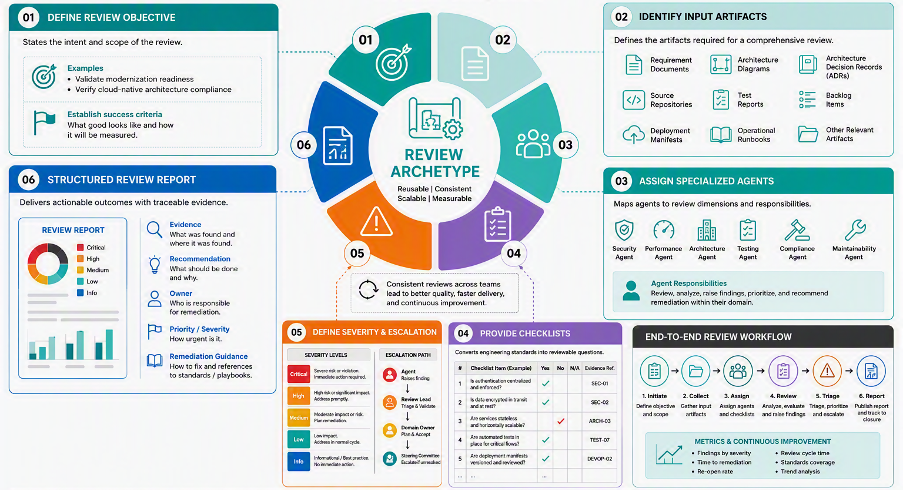
Figure: A Reusable pattern for a class of review work through Agent Archetype
A good archetype normally contains six elements. First, it defines the review objective, such as “validate modernization readiness” or “verify cloud-native architecture compliance.” Second, it identifies the input artifacts, including requirement documents, architecture diagrams, Architecture Decision Record(ADRs), source repositories, test reports, backlog items, deployment manifests, and operational runbooks. Third, it assigns specialized agents to review dimensions such as security, performance, architecture, testing, compliance, and maintainability. Fourth, it provides checklists that convert engineering standards into reviewable questions. Fifth, it defines severity levels and escalation paths. Finally, it creates a structured review report with evidence, recommendation, owner, priority, and remediation guidance.
5. Checklist-Based Review through Multi-Agent Collaboration
Checklist-based review makes agent behavior more reliable. A checklist gives the agent a stable control framework and reduces the risk of random observations. In a multi-agent model, each agent owns a checklist category. The Security Agent checks authentication, authorization, secrets, input validation, dependency risk, and data protection. The Architecture Agent checks modularity, integration style, runtime topology, scalability, resiliency, and observability. The Quality Agent checks naming, maintainability, testability, duplication, and readability. The Performance Agent checks latency risks, memory usage, database access patterns, caching, and concurrency. The Compliance Agent checks regulatory, audit, and enterprise policy alignment.
At the center of the model is an Orchestrator Agent. It receives the review request, gathers the context, selects the relevant archetype, dispatches the work to specialized agents, consolidates the findings, removes duplicates, assigns severity, and prepares a final review summary. A Critic Agent or Validation Agent can then examine the consolidated output to check whether each finding is evidence-based, actionable, and aligned with the checklist. This final validation step is essential because review agents should not create noise. A good review report is concise, traceable, and useful to a human decision-maker.
| Agent Role | Primary Responsibility | Example Checklist Questions |
| Orchestrator Agent | Coordinates the review workflow and consolidates findings. | Which archetype applies? Are findings duplicated? Which issues require human escalation? |
| Design Review Agent | Validates requirement clarity, user journeys, and acceptance criteria. | Are requirements testable? Are edge cases documented? Are personas and workflows consistent? |
| Architecture Review Agent | Reviews structural fit, integration choices, security zones, and operational readiness. | Does the design follow reference architecture? Are resiliency patterns adequate? Is observability covered? |
| Code Review Agent | Inspects source code, pull requests, tests, dependencies, and configuration. | Does the code meet acceptance criteria? Are APIs valid? Are tests sufficient? Are secrets avoided? |
| Security Agent | Checks secure design and secure coding controls. | Are protected paths guarded? Is input validated? Are dependencies trusted? |
| Critic Agent | Validates the relevance, evidence, and actionability of findings. | Is the finding supported by evidence? Is the recommendation practical? Is severity justified? |
6. Greenfield Application Development Example
Consider a greenfield product development initiative for a cloud-native customer onboarding platform. The team starts with product epics, user stories, API specifications, domain models, and a proposed microservices architecture. The Design Review Agent checks whether the user journeys are complete, whether exception paths are considered, and whether acceptance criteria are measurable. The Architecture Review Agent examines whether the service boundaries are appropriate, whether synchronous and asynchronous integrations are used correctly, and whether the platform aligns with container, API gateway, identity, observability, and deployment standards.
When implementation begins, the Code Review Agent reviews every pull request against the product archetype. It checks whether the generated code implements the story rather than a loosely inferred version of it. It verifies API contract compatibility, unit test coverage, error handling, logging, and secure coding practices. A Performance Agent may flag excessive database calls in a customer search API, while a Security Agent may identify that a new endpoint lacks authorization checks. The Orchestrator Agent then produces a consolidated review report with clear recommendations, allowing human reviewers to focus on product and architectural judgment rather than repetitive checks.
7. Brownfield Java Upgrade Example
In a brownfield Java upgrade program, the challenge is different. The application may have legacy frameworks, outdated libraries, deprecated APIs, fragile test coverage, and hidden runtime assumptions. A Java Upgrade Review Archetype can combine dependency analysis, framework compatibility review, API deprecation checks, build pipeline validation, test coverage review, and runtime behavior assessment. The Architecture Review Agent can identify whether the current packaging model supports the target runtime. The Code Review Agent can detect deprecated language constructs, unsafe reflection usage, old serialization patterns, and library conflicts.
For example, while upgrading from Java 8 to a newer long-term support version, the agents may inspect build files, identify unsupported plugin versions, check for use of removed JVM options, analyze third-party dependencies, and propose remediation steps. The Security Agent may also highlight libraries with known vulnerabilities, while the Test Agent can point out modules where regression coverage is too shallow. The review output becomes a modernization backlog rather than a generic list of warnings. This makes the upgrade more predictable and easier to govern.
8. Cloud-Native Migration Example
For cloud-native migration, the review archetype should focus on platform fit, deployment topology, data gravity, resiliency, security, monitoring, and cost. The Design Review Agent validates whether migration goals are clear: reduce infrastructure cost, improve scalability, increase release frequency, improve resilience, or enable faster product innovation. The Architecture Review Agent checks whether the chosen migration pattern is appropriate. Some applications may be suitable for containerization, while others may require deeper refactoring into cloud-native services.
A Cloud-Native Review Agent can inspect Kubernetes manifests, infrastructure-as-code templates, identity configurations, network policies, autoscaling rules, health probes, secrets management, logging, metrics, tracing, and release pipelines. In a migration from a monolithic Java application to a container platform, the agent may flag that session state is stored locally, that configuration is bundled inside the artifact, or that background jobs are tightly coupled with web processing. These are not merely code defects; they are architectural migration risks. By exposing them early, agents help the team decide whether to rehost, re-platform, refactor, or redesign specific parts of the application.
9. Application Modernization Example
Application modernization usually spans business capability mapping, technical debt reduction, platform renewal, API enablement, data modernization, and operational transformation. A Modernization Review Archetype can be designed around domains such as functional decomposition, dependency mapping, data ownership, integration simplification, security improvement, observability readiness, and release automation. The Design Review Agent can check whether modernization scope is tied to business outcomes rather than technology enthusiasm. The Architecture Review Agent can identify whether bounded contexts are clear, whether APIs are stable, and whether shared data stores are creating coupling.
In a brownfield modernization program, agents can parse repository structures, dependency graphs, database schemas, interface contracts, batch schedules, and operational incidents. They can convert this evidence into a heat map of modernization candidates. For example, one module may be high risk because it has poor test coverage, outdated dependencies, and frequent production incidents. Another module may be a good candidate for early API enablement because it has stable business logic and limited coupling. This evidence-based view allows modernization to proceed as a sequenced engineering roadmap instead of a large, risky rewrite.
10. Operating Model and Governance
AI-based review must be governed carefully. Agents should have access only to approved repositories, documents, standards, and tools. Their findings should be traceable to evidence, not presented as unsupported opinions. Severity definitions must be agreed in advance. A failed checklist item should not automatically block delivery unless it belongs to a defined control category such as security, compliance, production stability, or data protection. Human reviewers should remain accountable for final decisions, especially when trade-offs involve business risk, regulatory obligations, customer impact, or architectural direction.
A practical governance model includes agent versioning, checklist ownership, prompt and policy review, audit trails, feedback loops, and periodic calibration. When a human reviewer marks a finding as useful, incorrect, duplicate, or low-value, the feedback should improve future reviews. In mature setups, the organization can measure review effectiveness through defect leakage, cycle time, false-positive rate, remediation time, policy compliance, and developer satisfaction. This keeps the agent ecosystem focused on engineering value rather than novelty.
11. Conclusion
AI agents can significantly strengthen design, architecture, and code review when they are implemented as governed engineering capabilities rather than casual assistants. Boilerplate skills provide reusable review functions. Specialized agents apply those skills to specific quality dimensions. Archetypes make review patterns repeatable across greenfield and brownfield delivery scenarios. Checklist-based orchestration brings consistency, while multi-agent collaboration adds depth and specialization.
The future of AI-infused SDLC will not be defined only by how quickly teams can generate code. It will be defined by how confidently they can validate what gets generated, how well they preserve architectural integrity, and how responsibly they scale engineering judgment. Organizations that develop review agents as reusable, checklist-driven, and human-supervised capabilities will be better positioned to modernize applications, migrate to cloud-native platforms, upgrade technology stacks, and build new digital products with speed as well as control.