

AI is no longer a side project. It’s quietly shaping the decisions that shape us from who we hire to what we build next.
Artificial intelligence is no longer futuristic, it’s already here.
It shapes how we recruit, sell, forecast, and even make executive decisions. From HR platforms screening thousands of CVs to marketing engines predicting customer churn, AI now quietly shapes daily operations in nearly every major enterprise.
But as AI systems grow more complex, so do their risks.
Bias, opacity, data misuse, model drift, or even overreliance on AI outputs can all cause serious business, ethical, and reputational damage.
This raises an uncomfortable question: who actually owns the risk of AI?
For most organizations, the answer is no one clearly does.
And that’s exactly where AI Governance and Enterprise Architecture must meet.
Architecture Is the Hidden Backbone of AI Governance
AI Governance is often seen as a compliance problem, something for legal teams or risk officers to handle.
In reality, it’s also an architectural challenge.
AI doesn’t live in isolation. It consumes enterprise data, depends on cloud services, interacts with APIs, and influences real business processes.
Governance, therefore, can’t rely on policies alone, it must be designed, structured, and embedded into the architecture itself. For instance, companies like Microsoft and Google have embedded AI governance directly into their architectural blueprints creating internal AI Ethics and Risk Committees that review model design before deployment.
This proactive structure ensures compliance and builds trust long before a model reaches production.
That’s where architects come in the people who define how AI components fit into the enterprise ecosystem. In this context, architecture becomes the technical backbone of responsible AI.
Who Actually Owns AI Risk?
In mature organizations, AI risk is never owned by a single function.
It’s distributed across multiple layers of accountability.
The complexity of AI means that no one team can fully understand or control its behavior end to end.
Ownership must therefore be shared: deliberately, transparently, and architecturally. Some financial institutions already apply this shared model under the EU AI Act, where both technical and business leaders must document risk ownership for high-impact algorithms such as credit scoring or fraud detection.
Here’s how the responsibility typically unfolds:
| Role | Primary Responsibility |
| Enterprise Architects | Define the structural foundation for AI ensuring data flows, integration points, and technical standards support transparency, traceability, and compliance. They design the guardrails that keep innovation within the boundaries of governance. |
| Business Owners | Own the purpose of AI. They define the business problem, measure outcomes, and determine what level of risk is acceptable. They must understand that every algorithmic decision is ultimately a business decision not just a technical one. |
| AI Governance Board / Risk Committees | Act as the oversight mechanism. They establish ethical, regulatory, and operational standards for AI use, monitor adherence, and ensure accountability frameworks exist across teams. |
| Developers and Data Scientists | Bring governance to life at the operational level. They ensure that models are explainable, reproducible, and auditable documenting data lineage, performance metrics, and model behavior across environments. |
| Everyone | Whether approving a design, using an AI tool, or making a decision based on model output every employee participates in responsible AI use. Awareness and ethical literacy are as important as code or policy. |
In other words, AI Governance is not a department, it’s an ecosystem of shared responsibility.
Enterprise Architects connect the dots, Business Owners set the direction, Data Scientists implement, and Governance Boards oversee. But the real maturity comes when everyone in the organization, from the C-suite to the operational level, understands that AI is a shared asset and a shared risk.
When ownership is clear, accountability becomes part of the architecture itself not an afterthought.

AI Governance Responsibility Map
Typical Mistakes Companies Make
Despite the excitement around artificial intelligence, many organizations still fall into the same traps.
Not because they lack technology, but because they lack governance discipline and architectural thinking.
Below are some of the most common and costly mistakes seen across enterprises.
- Treating AI as a “Technology Project”
AI isn’t something to implement, it’s something to govern. Many teams build models fast but without accountability, ethical boundaries, or lifecycle control. Projects launch quickly and fade just as fast. AI must be managed as a strategic business capability, not an experiment. - No Ownership After Deployment
Once a model goes live, responsibility often disappears. Without clear owners or monitoring, accuracy drifts and decisions lose reliability. Mature organizations assign AI product owners and model stewards to ensure every algorithm has a custodian. - No “Human in the Loop”
Full automation without oversight is risky. Critical decisions (hiring, lending, healthcare) must always include human validation. True maturity means augmented intelligence, not autonomous AI. - Unclear Data Lineage
If a company can’t trace where its model data comes from or how it’s used, trust collapses. Governance starts with transparency: catalogs, metadata, and tracking tools must make data lineage visible. - “Compliance in PowerPoint”
Many firms have polished AI policies, that live only in slides. Real governance exists in code, systems, and automation. If it’s not enforced technically, it doesn’t exist.
The pattern behind all these mistakes is simple: AI fails when governance is detached from architecture. When policies live separately from systems, risk becomes invisible and invisible risks are the ones that cost the most.
How Architecture Enables AI Governance
Modern enterprise architecture is no longer only about connecting systems. It’s about connecting responsibility. The moment artificial intelligence becomes part of the business fabric, architecture must evolve to ensure that governance isn’t something external or reactive, it’s embedded in the very design of every AI-enabled solution.
A well-structured architecture acts as the nervous system of governance: it defines how data flows, how models operate, how risks are tracked, and how accountability is maintained across the entire lifecycle. Here’s how this can be achieved in practice:
- AI Lifecycle Framework
Establish a clear, repeatable process from idea to decommissioning, with checkpoints for approval, risk, ethics, and validation. Governance should travel with the model, not chase it after deployment. - AI Risk Register
Treat models like enterprise assets with owners, purpose, and risk levels. A central register connects business risk and architecture governance, keeping every algorithm visible and accountable. - Explainability by Design
Every model must be understandable to scientists, auditors, and regulators alike. Documentation, model cards, and versioning make explainability a built-in feature, not an afterthought. - Data Lineage & Catalogs
Governance starts with knowing your data. Integration with catalogs and metadata systems provides transparency on how data enters, transforms, and feeds models. - Monitoring & Audit Dashboards
AI evolves constantly. Continuous monitoring through platforms like ServiceNow, Domo, or Azure Monitor tracks drift and performance in real time. This is where architecture meets assurance.
When done right, architecture transforms governance from a bureaucratic burden into an enabler of trust.
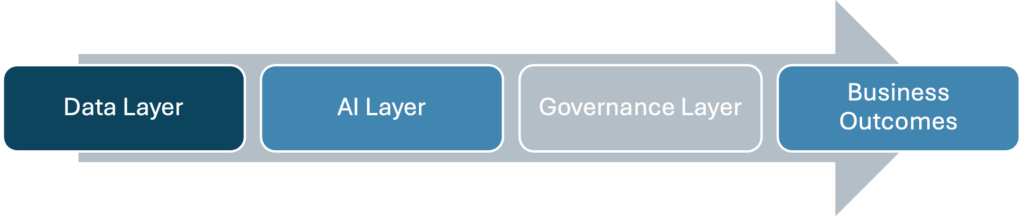
AI Governance Embedded in Architecture
For example, IBM’s WatsonX platform integrates lifecycle governance into its architecture combining model documentation, lineage tracking, and bias monitoring within one operational layer.
It’s a glimpse of how governance can become a built-in architectural capability rather than an afterthought.
Instead of slowing innovation, it provides the structure and visibility needed to innovate safely turning AI from a regulatory concern into a strategic advantage.
Regulations and Standards to Watch
AI Governance is no longer just a best practice, it’s rapidly becoming a legal and regulatory obligation.
Across the world, governments and institutions are formalizing how organizations must design, test, and operate AI systems. For enterprise architects, this shift marks a turning point: compliance must now be designed into the architecture, not added after the fact.
Below are the key frameworks and standards shaping the future of responsible AI:
🇪🇺 EU AI Act
The EU AI Act is the first comprehensive law on artificial intelligence.
It classifies systems into four risk levels minimal, limited, high, and unacceptable with strict rules for high-risk use cases such as hiring, finance, and healthcare.
In 2025, several European banks began pilot programs introducing audit trails and algorithm registries to prove compliance.
Architects must now design platforms that can demonstrate transparency and traceability by default.
ISO/IEC 42001:2023 — AI Management Systems Standard
This new global standard defines what a Responsible AI Management System (AIMS) should look like.
It mirrors ISO 27001 and 9001, but focuses on AI governance, risk control, and accountability.
For organizations, it serves as a blueprint for scaling responsible AI across architecture and process.
OECD AI Principles
Adopted by 40+ countries, these principles promote human-centric, fair, and transparent AI.
For architects, they mean embedding human oversight and explainability into system design.
🇺🇸 NIST AI Risk Management Framework (RMF)
Created by the U.S. NIST, this framework guides the design of trustworthy AI.
Its core principles (validity, reliability, privacy, and resilience) provide architects with a technical reference for risk control and monitoring.

Global AI Governance Standards Map
The Architectural Imperative
For enterprise architects, understanding these frameworks is not optional, its mission critical.
AI compliance is no longer achieved through policy documents alone; it must be codified into data flows, platform configurations, and model lifecycle processes.
A compliant architecture is not just safer, it’s sustainable, scalable, and trusted by regulators, customers, and partners alike.
In short, architecture is now the bridge between AI innovation and AI regulation. And those who design with compliance in mind will be the ones shaping the future of responsible technology.
The Future Role of the Architect
The role of the architect is evolving faster than ever.
Tomorrow’s architect will not only design systems, they will translate AI risk into actionable architectural decisions.
Their work will sit at the intersection of technology, governance, and ethics, connecting the dots between data scientists, legal teams, and executives to ensure that AI innovation aligns with both business goals and regulatory expectations.
In this new landscape, architecture becomes the language of trust. Architects will design not just for performance or scalability, but for accountability, transparency, and control, building AI systems that organizations can explain, audit, and improve responsibly.
Emerging Roles in the Age of AI
New hybrid roles are already appearing within forward-looking enterprises:
- AI Architect — designs scalable, compliant, and explainable AI platforms, embedding governance into technical design.
- Responsible AI Officer — defines, monitors, and enforces ethical AI principles across the organization.
- Model Risk Architect — manages the lifecycle of AI models, ensuring traceability, explainability, and bias mitigation.
For instance, PwC and Accenture have introduced dedicated AI Governance Architect roles — professionals responsible for aligning technical, regulatory, and ethical aspects of AI deployment across large client portfolios.
These roles signal a broader shift: AI governance is no longer a policy document. It’s an architectural discipline.
From Control to Enablement
AI governance is often seen as a constraint, but in truth, it’s the opposite. When governance is embedded into architecture, it enables innovation instead of restricting it.
It creates a foundation where experimentation is safe, transparency is built-in, and every decision is traceable.
Leading companies like Salesforce and SAP now describe AI governance as a form of innovation enablement using architectural standards and data transparency to accelerate safe experimentation rather than slow it down.
In this sense, architecture becomes the silent force that allows organizations to innovate responsibly balancing creativity with control, ambition with accountability.
The real question for modern enterprises is no longer whether they will use AI, but how they will use it: safely, ethically, and transparently.
In Summary
The best AI architectures are not just technically brilliant, they are responsible by design.
And perhaps the true measure of AI maturity is not how many models a company has deployed,
but how many risks it understands, manages, and owns.
Because in the era of intelligent systems, responsibility is the new architecture.
ABOUT NADZEYA STALBOUSKAYA
Nadzeya Stalbouskaya is an award-winning Technology Architect, prolific author, and recognized international conference speaker. With numerous publications across respected global journals and magazines, she is widely regarded as one of the emerging voices shaping the future of enterprise architecture and digital transformation. Nadzeya is an active member of leading industry organizations, serving as ambassador and advisor to global communities where she promotes knowledge exchange, governance excellence, and innovative architectural thinking. She has spoken at some of the most prestigious events in Europe, inspiring thousands of professionals with practical strategies for addressing architecture debt, building resilient systems, and accelerating business transformation.