

By Santi Chakrabarti
Strategic programmes rarely fail at the start. They fail gradually, quietly, despite compelling business cases, enthusiastic sponsors, and significant investment. Technology initiatives start on time and within budget, and still fail to produce the value they promised. When organisations look for explanations, they typically look in the wrong places: at the technology, the vendor, the implementation team. The real problem is almost never in the technology layer. It is misalignment.
Misalignment is not a failure of effort or intent. It is a structural problem that requires structural solutions. This is precisely why Enterprise Architecture exists.
At its core, EA is an alignment discipline. It connects business strategy to technology capability. It translates intent into actionable design. It ensures that every significant change to an organisation’s landscape reinforces its strategic direction.
It is worth being clear about what architecture is not. Architecture is neither about finding the right solution nor about making technology decisions. It is the discipline of creating the conditions in which good decisions can be made – consistently, at every level, by the right people, at the right time. The measure of great architecture is not the quality of the artefacts it produces. It is the quality of the alignment it enables.
This article examines the misalignment problem in modern enterprises, explores the mechanisms through which EA restores coherence, and makes the case that architecture’s greatest contribution to an organisation is not documentation, frameworks, or governance. It is the structural alignment that helps strategy to reach successful execution.
Why misalignment happens?
Technology Disruption
Technological change is continuous. Fast-changing technology platforms put organisations under constant pressure to stay relevant. The problem is not that organisations fail to adopt new technologies. Many adopt too many, too fast, without a coherent view of how each capability connects to the others or to the business problems they are meant to solve. Too often, organisations tend to solve immediate problems with tactical solutions that deepen complexity and introduce gaps in the longer term.
Shifting Business Demand and Priorities
On the business side, the pressure is no less intense. Operating models must shift to serve new customer expectations, regulatory requirements evolve continuously, and market positions that were stable for decades become contested within quarters. Each of these forces generates legitimate change demand – but that demand rarely arrives in a sequenced, prioritised form. Business units submit requests from their own vantage points, with their own urgency, without visibility into the cumulative impact on shared capabilities or the consequences for other parts of the enterprise. The result: duplicate capabilities, conflicting data definitions, and technology landscapes that are perpetually mid-transformation, never fully resolved.
Absence of discipline and governance
Most organisations underinvest in the governance structures and organisational design needed to translate strategy into coherent execution. When architectural decisions are made without effective governance, the gap between business vision and technology reality widens, often invisibly, until it becomes structurally damaging. Technical debt accumulates not as a planned trade-off. What today’s organisation leaves ungoverned, tomorrow’s must pay to untangle.
Consider a manufacturing company initiating a strategic programme to implement future-proof engineering processes. The business case is approved, investment is committed, and the programme begins with genuine momentum. Over time, the initiative begins to fragment. Ownership of key decisions becomes unclear as the programme spans multiple business units and technology teams. Without a cross-cutting function to facilitate resolution, decision-making slows, priorities conflict, and the programme loses coherence.
The outcome is familiar: the programme either stalls entirely, or arrives at a tactical compromise that preserves much of the complexity it set out to remove.
This is not a failure of ambition or funding. It is a failure of alignment.
How Architecture performs alignment?
Understanding the current state
Understanding the current problem is the first step. A good architect engages with business, surfaces the pain points, develops a precise understanding of the problem that actually needs solving. A good architect does not arrive with solutions; they arrive with questions. Documenting the current state – covering the business, data, application, and technology layers – with a shared understanding of context creates a solid foundation.
Identify the stakeholders, their concerns & requirements
This is a critical stage yet it is the one most frequently compressed or ignored. A core responsibility of the architect is stakeholder alignment, and that begins long before any design work takes place. With a clear view of the problem and the change it demands, the architect identifies who is materially affected, engages them deliberately, and takes the time to understand what the proposed change means for them, their processes, concerns, risks. Stakeholders who feel unheard at this stage become blockers later. Equally important, the architect plays an active role in surfacing and refining requirements. What stakeholders ask for and what they actually need are rarely the same – closing that gap before it becomes embedded in the design is one of the architect’s most important responsibilities.
Develop Architecture view that addresses concerns & requirements
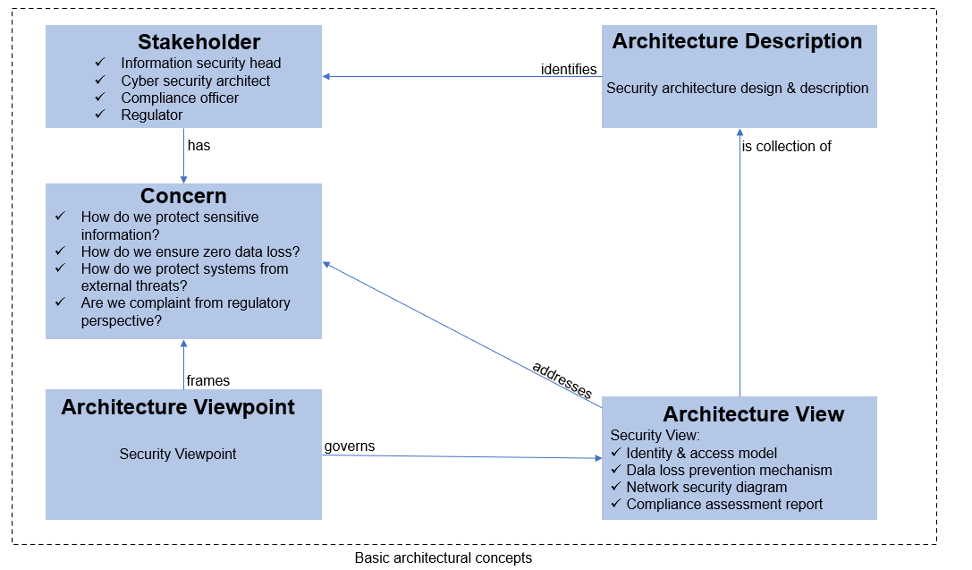
With stakeholders identified and their concerns understood, the very next step for the architect is to develop architecture views from viewpoints. A view is what you see – a representation of the overall architecture meaningful to one or more stakeholders. The viewpoint, by contrast, is the perspective – where you look from. The viewpoint frames the concern and the view addresses the concern. The architecture view is where practitioners demonstrate their skill in simplifying complexity, bringing meaningful context amidst chaos.
Take security as an example. As the architect engages with the project, the security stakeholders are identified. The architect develops a Security Architecture View. The diagram below illustrates how stakeholders’ concerns are addressed by the architecture view.
Facilitate trade-off
In practice, no single architecture view satisfies every stakeholder equally. Competing concerns – security versus performance, cost versus resilience, speed of delivery versus long-term maintainability – mean that trade-offs are inevitable. This is not a failure of the architecture process; it is precisely where architecture earns its value. Rather than imposing a resolution, the architect creates the conditions for an informed decision. This typically involves assessing the impact of each option across all affected areas, evaluating alternative solutions with consequences made explicit, and conducting risk reviews that surface what is being accepted, mitigated, or deferred.
The goal is not to come to an agreement for its own sake. It is to ensure that a trade-off is made with full transparency of what is being gained, what is being sacrificed, and who bears the consequences. Architecture does not make that choice. It ensures the choice is never made blindly.
Conclusion
Misalignment between business intent and technology delivery is not an exception in modern organisations. Enterprise Architecture exists to address this gap. Architect practitioners follow a structured approach: beginning with a precise understanding of the problem, developing architecture to address concerns from stakeholders and facilitating the trade-off conversations that turn conflicting concerns into conscious decisions. The organisations that close this gap consistently are not those with the largest technology budgets. They are those with the discipline to keep strategy and execution aligned – and the architectural practice to make that discipline permanent.
Santi Chakrabarti is a Solution Architect at the Williams Racing F1 Team, with extensive experience delivering enterprise and solution architecture across large-scale transformation programmes in the manufacturing sector. Over the course of his career, Santi has led architecture workstreams on complex, cross-functional initiatives — translating business strategy into coherent technical design. He holds the TOGAF Enterprise Architecture certification.