

Enterprise AI agents are moving from simple prompt-driven assistants to complex systems that plan, reason, retrieve information, invoke tools, evaluate outcomes, and collaborate with human teams. This shift has created a new architectural concern: the quality of the agent’s cognition. A strong agent is not only measured by the size of its underlying model or the number of tools it can call. It is measured by how consistently it understands intent, preserves relevant context, filters noise, and explains its actions in a way that humans and systems can trust.
Two failure patterns often weaken agentic systems in production: cognitive disconnect and context fatigue. Cognitive disconnect occurs when an agent’s interpretation, reasoning path, or action plan drifts away from the human objective, business rule, or system reality. Context fatigue appears when the agent is overloaded with too much history, stale information, duplicated instructions, noisy retrieval results, or long tool traces, causing the model to miss the most important signal. Both problems are especially visible in AI-enabled software development lifecycle workflows, where agents must understand requirements, generate code, run tests, review pull requests, and support deployment decisions under governance controls.
Understanding Cognitive Disconnect in Agent Architecture
Cognitive disconnect is a gap between what the agent thinks it is doing and what the user, product owner, architect, or system actually expects. In an AI-SDLC scenario, this may happen when a coding agent interprets a requirement too literally, ignores a non-functional constraint, or optimizes for passing unit tests while weakening security, maintainability, or architectural alignment. The agent may produce a technically valid output, but the output fails to reflect the larger design intent.
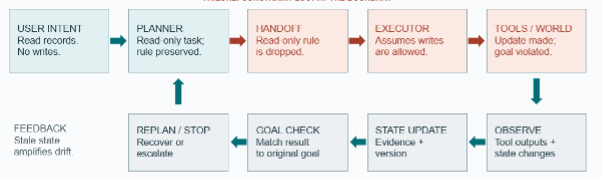
Figure: Cognitive Disconnect in Agent Architecture
For example, consider an agent assigned to modernize a legacy Java module into a Spring Boot microservice. The requirement states that the service should improve scalability and expose REST APIs. A cognitively disconnected agent may generate controllers, service classes, and repository layers but overlook transaction boundaries, domain invariants, audit logging, or backward compatibility with downstream systems. The code appears complete at the surface level, yet it does not preserve the enterprise architecture that gives the application its operational meaning.
The root cause is rarely a single bad prompt. It usually emerges from weak task framing, missing success criteria, hidden assumptions, unclear tool boundaries, or poor separation between planning, reasoning, execution, and verification. Reliable agent architecture therefore needs explicit cognitive scaffolding: structured goals, domain constraints, confidence checks, review gates, and feedback loops that keep the agent aligned with the intended outcome.
Understanding Context Fatigue in Agent Architecture
Context fatigue is different. Here, the agent may understand the goal, but the working context becomes too crowded for effective reasoning. Long conversation history, repeated instructions, unfiltered retrieval output, verbose logs, large files, and intermediate tool responses can compete for the model’s limited attention. Larger context windows help, but they do not remove the need for context design. A crowded context window can still bury the most relevant requirement in a mass of loosely related information.
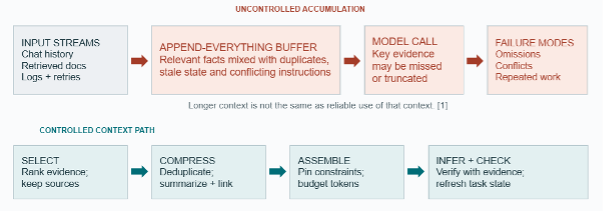
Figure: Cognitive Failure in Agent Architecture
In AI-SDLC work, context fatigue becomes visible during repository-level tasks. A development agent may be asked to fix a defect in a billing service. If the agent receives the entire repository summary, old defect discussions, previous failed patches, complete logs, generated test reports, and unrelated architecture notes, it may overfit to obsolete clues or miss the current failing test. The result can be a patch that appears reasonable but fixes the wrong layer, changes too many files, or introduces regression risk.
A mature agent architecture treats context as a curated asset rather than a dumping ground. The system should decide what to include, what to summarize, what to retrieve on demand, what to discard, and what to preserve as durable memory. This requires context compression, memory curation, retrieval ranking, artifact summaries, role-specific views, and traceable handoffs between agents. In practice, the goal is not to maximize context volume; it is to maximize context density. Here is a comparison table to understand Cognitive Disconnect and Context Fatigue in the agent architecture development.
| Feature | Cognitive Disconnect | Context Fatigue |
| Core meaning | The agent’s reasoning or action diverges from the intended goal, domain rule, or human expectation. | The agent receives too much, stale, duplicated, or low-value information and loses focus on the most relevant signal. |
| Primary failure mode | Misalignment of interpretation, intent, priorities, or constraints. | Attention dilution, noisy retrieval, stale memory, and excessive prompt load. |
| Typical AI-SDLC example | A coding agent implements a feature but ignores security controls, audit requirements, or architectural boundaries. | A defect-fixing agent scans too many logs and files, then patches a symptom instead of the root cause. |
| Common trigger | Ambiguous goals, missing acceptance criteria, weak governance, or unclear responsibility split between agents. | Long conversations, unfiltered repository context, verbose tool outputs, repeated instructions, or outdated artifacts. |
| Impact on agent behavior | The response may look correct but solve the wrong problem or violate hidden constraints. | The response may become inconsistent, overly broad, repetitive, or anchored to irrelevant information. |
| Model distillation risk | A smaller model may imitate outputs without learning the deeper decision logic or domain guardrails. | A smaller model may become highly sensitive to missing or noisy context if trained on poorly curated examples. |
| Detection method | Traceability checks, human review, intent-to-output comparison, policy validation, and rubric-based evaluation. | Context audits, retrieval relevance scoring, prompt-size monitoring, attention failure analysis, and error clustering. |
| Architectural remedy | Separate planning, reasoning, execution, and verification; define explicit success criteria and escalation rules. | Use context compression, memory curation, ranked retrieval, summary artifacts, and on-demand context loading. |
| Governance control | Pull request reviews, CODEOWNERS, design approval gates, policy-as-code, and accountable human sign-off. | Context budgets, retention policies, retrieval filters, artifact freshness rules, and observability for context usage. |
| Desired outcome | An agent that remains aligned with business intent and engineering standards. | An agent that reasons from concise, fresh, and high-signal context. |
AI-SDLC Examples: Where These Failures Appear
During requirements engineering, cognitive disconnect appears when an agent captures functional statements but misses the business rationale behind them. It may convert a stakeholder request into user stories without preserving compliance, usability, performance, or domain-specific constraints. Context fatigue appears when the same agent is flooded with interview transcripts, product notes, unresolved comments, and old backlog items without clear prioritization. A stronger design uses requirement intent cards, acceptance criteria, decision records, and traceability tags to keep business meaning connected to implementation work.
During design and architecture, cognitive disconnect occurs when the agent recommends a pattern that is theoretically sound but unsuitable for the system’s operational reality. For instance, it may suggest event-driven decomposition for a low-volume internal workflow where simplicity matters more than asynchronous scalability. Context fatigue, in contrast, may cause the agent to mix current architecture guidance with deprecated diagrams or outdated standards. Architecture agents should therefore rely on governed reference architectures, explicit trade-off matrices, and time-aware retrieval that separates active guidance from historical material.
During coding, cognitive disconnect often appears as code that satisfies the prompt but violates the team’s design conventions. An agent may generate a REST endpoint without applying validation, observability, error handling, or secure defaults. Context fatigue appears when the agent reads too many files and starts copying patterns from unrelated modules. A practical countermeasure is to provide the agent with a compact coding contract: target files, dependency rules, coding standards, test expectations, and rollback boundaries.
During testing, cognitive disconnect may lead the agent to generate tests that confirm its own assumptions instead of challenging the implementation. It may test only the happy path and ignore malformed input, concurrency, authorization, failure recovery, or data consistency. Context fatigue may show up when the agent receives too many logs and cannot distinguish the primary failure from secondary noise. Test agents should be guided by risk-based test design, mutation checks, failure clustering, and concise defect summaries.
During release and operations, cognitive disconnect is seen when an agent recommends deployment because automated checks passed but ignores change freeze windows, dependency readiness, service-level objectives, or unresolved approval gates. Context fatigue occurs when operational agents ingest large volumes of telemetry without isolating the few signals that matter. Production-grade architecture should combine observability summaries, policy checks, release readiness scoring, and human-in-the-loop approvals for decisions that carry business risk.
Model Distillation: Reducing Disconnect and Fatigue
Model distillation is often discussed as a way to reduce cost and latency by transferring capability from a larger teacher model to a smaller student model. In agent architecture, however, distillation should not be treated as model compression alone. It should also preserve task judgment, domain boundaries, refusal behavior, tool-selection discipline, and the ability to work with compact but meaningful context. A small model that is fast but poorly aligned can amplify cognitive disconnect. A small model that depends on excessive retrieved text can still suffer from context fatigue.
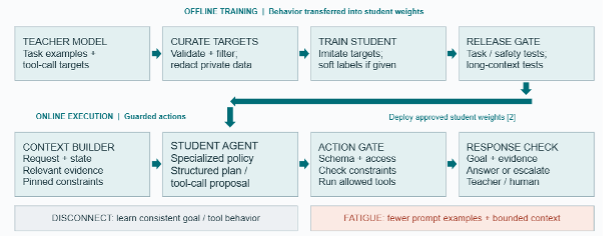
Figure: Reducing Disconnect and Fatigue in Model Distillation
For AI-SDLC agents, distillation can be shaped around realistic development traces. A teacher model can solve tasks such as requirement decomposition, secure code review, test generation, defect localization, and pull request summarization. The student model should then learn not only the final answer, but also the decision pattern: what evidence was relevant, which files were ignored, what constraints were checked, when human review was required, and how uncertainty was expressed. This produces smaller agents that are not merely cheaper, but also more disciplined.
Distillation can also reduce context fatigue by teaching the student model to operate with curated context packs. Instead of exposing the model to full repositories and long conversations, the training pipeline can include summarized design records, defect clusters, compact tool outputs, and ranked retrieval snippets. The model learns to ask for missing evidence rather than hallucinating from noisy context. This design is particularly useful for specialized agents such as code reviewers, security scanners, migration assistants, release copilots, and incident triage agents.
Design Principles for Stronger Agent Architecture
First, agents should be designed with clear cognitive boundaries. One agent may plan, another may implement, and a third may verify. This separation makes the system easier to inspect and reduces the chance that a single model will silently move from assumption to action without validation. For AI-SDLC, this means separating backlog interpretation, code generation, test creation, security review, and release recommendation into accountable stages.
Second, context must be managed as an engineered layer. The agent should not carry every previous interaction into every new decision. Instead, the platform should maintain short-term working memory, durable project memory, artifact summaries, and retrieval-on-demand. Each layer should have freshness rules, access controls, and relevance scoring. This makes the agent more economical, more reliable, and easier to debug.
Third, evaluation should test the agent’s reasoning behavior, not just its final answer. A code-generation agent should be evaluated on whether it respected constraints, selected the right files, avoided unnecessary changes, produced meaningful tests, and explained uncertainty. A distilled model should be measured against the same behavioral rubric used for the teacher model, with additional checks for context sensitivity and tool discipline.
Finally, the architecture should include human checkpoints where the cost of error is high. Agent autonomy is valuable, but autonomy without review can turn small misunderstandings into production incidents. In regulated or enterprise-critical systems, the agent should explain what it changed, why it changed it, what evidence it used, what risks remain, and where human approval is needed.
Conclusion
Cognitive disconnect and context fatigue are not minor prompting issues; they are architectural weaknesses that affect trust, safety, productivity, and maintainability. Cognitive disconnect breaks alignment between intention and action. Context fatigue weakens the agent’s ability to reason from the right evidence. In AI-SDLC workflows, these failures can appear in requirements, design, coding, testing, release, and operations. Model distillation can help, but only when it preserves judgment, context discipline, tool governance, and domain alignment. The future of agent architecture will belong to systems that do not merely generate faster responses, but reason with clearer intent, cleaner context, and stronger accountability.