

A capability-based assessment can help retirement services organizations identify modernization priorities, align technology investments with business needs and sequence change according to operational and regulatory risk.
By Karthikeyan Marappan
Retirement Services technology modernization efforts are most successful when replatforming discussions are aligned at the outset with how the business intends to grow, which products it plans to support and how it wants to serve those markets. Without that business context, vendor evaluations, integration planning and migration decisions for the future environment are based on an incomplete picture, increasing the likelihood that the new platform will inherit limitations that the modernization program was intended to resolve.
The consequences of replatforming without business alignment at the outset can become apparent after implementation. In those scenarios, the new platforms often struggle to support plan sponsors, serve participants, introduce products or manage regulatory requirements efficiently. Modernization efforts focused on replacing aging technology and improving maintainability without addressing the operating limitations that prompted the investment can leave the business working around many of the same constraints in a different system.
Client and market strategy create another set of requirements, since a provider serving small and midsize employees will need a different enrollment and servicing model from one supporting large plan sponsors through dedicated relationship teams. K-12 education and healthcare clients also bring different plan structures, contribution requirements and distribution relationships. Once the business direction is clear, modernization can be grounded in the capabilities required to execute it, including where the organization performs well today, where existing systems create limitations and which gaps carry enough business or regulatory significance to warrant investment.
Start With What the Business Must Be Able to Do
Business capabilities describe what an organization needs to be able to do, independent of the applications or systems used to support them. Participant enrollment remains a core capability whether it is handled through a legacy recordkeeping platform or technology introduced as part of a modernization program. The same applies to calculating a required minimum distribution, where the business obligation remains consistent even as the underlying calculation engine changes.
The distinction between a business capability and its supporting technology is particularly important in retirement services, where a single activity can extend across multiple systems and operating functions. A hardship withdrawal may involve participant servicing, eligibility and compliance rules, payment processing and data maintained in several applications, all of which contribute to fulfilling the same obligation to the participant. Considering each application independently can make the dependencies among those functions difficult to identify, while viewing them as part of a shared business capability provides a clearer picture of how they work together.
The same issue exists when mapping the broader retirement services operation. A recordkeeping platform may support substantial portions of plan and participant servicing, transactions, claims, investments and finance, although capabilities such as pre-sales and request for proposal (RFP) support or new-business onboarding are handled through CRM, sales-enablement and other systems. Mapping the business by capability makes those relationships visible and provides a more complete view of the technology involved in delivering them. Figure 1 illustrates this broader capability landscape and the portion typically supported by the recordkeeping platform.
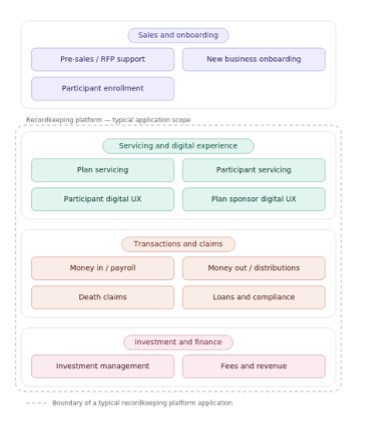
Figure 1. A retirement services capability map shows how the typical recordkeeping platform supports only part of the broader business capability landscape.
A capability map enables organizational teams to see the full operational landscape before evaluating replacement platforms, which can prevent a modernization program from reproducing existing limitations. In a like-for-like replacement, newer technology can preserve gaps in how the business operates if the existing application structure becomes the basis for defining what its replacement should support. Understanding those gaps at the capability level gives teams a clearer basis for determining which applications should be retained, extended or replaced.
Invest According to Business Value
Capability mapping becomes more useful when it reflects how the organization competes, since modernization dollars and engineering resources should not be distributed evenly across every function in the business. Some capabilities directly support the products, services or client experience that distinguish the company in its market, whereas others are essential to operations but can be handled effectively through standard solutions. The classification will vary among retirement-services providers because their product mix, client base and growth strategy create different priorities.
An annuity provider may need to invest more heavily in product pricing and payout administration because those capabilities contribute directly to its competitive position. A company whose growth depends on serving K-12 or healthcare plan sponsors may place greater value on sponsor servicing and participant communications, reflecting the requirements of those markets and the experience it wants to deliver. At the same time, essential functions such as general ledger accounting and document imaging can often be handled through standard solutions, avoiding extensive customization that adds cost and consumes engineering capacity without strengthening the capabilities that distinguish the business.
Investment decisions made at the capability level can therefore shape the architecture as well as the modernization roadmap. An outsized investment in a commodity function reduces the resources available for capabilities that support growth or differentiate the business, and insufficient investment in a high-value capability can leave the organization constrained by the same limitations it set out to address. With product direction, distribution, client segments and growth priorities providing the business context, technology teams have a stronger basis for determining where specialized investment is warranted and where standard solutions are sufficient.
Turning Capability Analysis Into a Modernization Roadmap
In practice, I use a Capability-Application Alignment Model built around five related areas: capability inventory, maturity, criticality, application alignment and sequencing. The inventory needs enough detail to expose how work actually happens and enough structure to guide investment decisions.
Building the inventory requires structured work between business and technology teams. In my experience, Domain-Driven Design workshops provide an effective way to bring subject-matter experts together around the operating environment as it functions in practice. Working through the business processes, people, applications and upstream and downstream dependencies involved in delivering each capability, often uncovers details that application inventories alone do not reveal. A process that appears automated at a high level may still depend on spreadsheets, manual reconciliation or knowledge held by a small number of employees, and several applications may support portions of what the business regards as a single capability. The reverse can also occur, with one application accumulating responsibilities that belong to several distinct business domains.
A business reference architecture adds the technology view by mapping existing assets to the capabilities they support, giving business and technology teams a shared picture of the current state and where the gaps exist. From there, capability maturity can be assessed along a practical progression from manual to standardized, automated and eventually adaptive or AI-augmented. Accuracy matters more than an aspirational maturity score because a process that runs consistently through the experience of employees who know how to compensate for system limitations is fundamentally different from a genuinely automated capability, even if both appear successful on an executive dashboard.
Maturity becomes meaningful for modernization planning when it is considered alongside criticality, since an immature capability may present limited business risk even though another can directly affect regulatory compliance, participant experience or revenue. In retirement services, I evaluate criticality according to regulatory exposure, participant impact and cost or revenue sensitivity. Distribution processing demonstrates the relationship particularly well because an error can create compliance exposure, affect a participant directly and generate substantial remediation costs, whereas temporary limitations in an internal reporting function may carry considerably less operational risk. Evaluating maturity and criticality together gives the organization a stronger basis for prioritization than application age alone.
With those assessments in place, capability gaps can be mapped to application decisions based on what the business actually needs to improve. The appropriate response may involve extending an existing application, introducing an integration layer, replacing part of the legacy environment or moving the capability onto a new platform, and those decisions collectively begin to establish the modernization sequence.
Practical pressures such as contract expirations, vendor availability and implementation windows will inevitably influence the roadmap, although they should not become the primary basis for deciding what gets modernized first. Ultimately, the greater priority should go to capabilities carrying significant business exposure and large maturity gaps, where improvement can reduce meaningful risk or create operating value and give the organization a roadmap tied to business need rather than the lifecycle of its existing applications.
Choosing the Modernization Path After the Capability Work
Capability priorities provide the business context for deciding how the supporting technology should change, and the answer does not have to be the same across the organization. Some parts of the legacy environment may warrant incremental replacement, others can continue operating effectively behind APIs or an integration layer, and certain capabilities may justify migration to a modern or SaaS platform. Each approach carries different implications for cost, implementation risk, technical debt and the amount of control the organization retains.
I have found incremental modernization particularly useful because replacing the legacy environment in stages allows the business to continue operating throughout the transition. Teams can validate individual capabilities as they move into the new architecture, reducing the disruption associated with a large migration, although careful sequencing is essential wherever old and new systems must coexist for an extended period.
Wrapping a reliable legacy core with APIs or an integration layer offers a different path, particularly where the more immediate constraints involve access to existing functionality and interoperability with newer applications. The organization can expose existing functionality to newer applications and digital experiences without committing immediately to a full replacement, providing greater flexibility even though the technical debt within the core will still need to be addressed.
A full migration to a modern or SaaS platform may make sense when a larger portion of the existing environment no longer supports the capabilities the business needs or the organization has a compelling reason to consolidate technology on a scale. Platform breadth alone, however, is a poor measure of fit. Configuration, extensions, integrations and operating processes still have to support the provider’s particular products, clients and servicing model, which brings the decision back to the capability analysis completed earlier.
The appropriate modernization path may consequently vary from one capability to another, with standardized solutions often serving commodity functions effectively and differentiating capabilities sometimes warranting greater control or custom engineering. Modern developer tooling and AI-assisted engineering are also changing the economics behind those choices, giving organizations more flexibility in deciding where third-party platforms provide sufficient value and where greater internal control may be justified.
In practical terms, a modernization strategy becomes more defensible when each technology decision can be traced back to the business capability it is intended to improve. That connection gives leadership a practical basis for choosing among incremental replacement, integration around the legacy core, platform migration or custom development according to the value, maturity and criticality of the capability involved.
Capability Boundaries Can Strengthen API Design
The capability analysis developed for modernization can also inform API architecture, particularly in environments where integrations have accumulated around individual applications over time. APIs designed according to the data owned or exposed by those applications tend to carry existing system boundaries into the integration layer, creating dependencies on technology the organization may eventually replace. Domain-Driven Design gives architecture teams a way to organize APIs around the more durable business domains identified through the capability work.
In retirement services, that architecture could be structured across three foundational layers. Data APIs provide controlled access to underlying data stores, with Business Service, or Domain, APIs holding the rules and data associated with areas such as employer or sponsor, participant, investments and funding sources. Transactions that require information or logic from several domains are coordinated through an orchestration layer, allowing each domain to maintain responsibility for the business rules that belong there.
Participant eligibility and contribution processing illustrate how that structure works in practice. Rules governing those activities can remain within the relevant business domain and be applied consistently wherever the capability is used, avoiding multiple versions of the same logic embedded across front-end applications. Changes to an underlying data platform can then be handled without relocating the business rules associated with the domain, and a participant or sponsor interface can evolve without requiring those rules to be rewritten.
Stable domain boundaries are particularly valuable in retirement services because they allow individual layers to evolve independently, even as platforms, interfaces and regulatory requirements change on different schedules. They also prevent an update in one part of the environment from becoming a broader integration effort and create clearer points for security and compliance controls. Authentication, authorization and least-privilege access still need to operate throughout the architecture, especially where participant financial and personal data is involved, with domain ownership helping to establish where access requirements belong and who is accountable for them.
AI agents will make that accountability increasingly important as they begin interacting directly with retirement-services APIs. Permissions for those agents will need to correspond to the business activities they are authorized to perform, with narrow access, appropriate auditability and controls that reflect the sensitivity of the underlying data. The capability and domain structure established during modernization gives organizations a practical foundation for defining those boundaries as AI becomes more active in retirement servicing.
Modernization Should Leave the Business More Adaptable
Retirement services organizations will continue to modernize aging recordkeeping and servicing environments as business requirements shift, regulatory demands increase and legacy technology becomes more difficult to support. Cost, implementation time and operational disruption inevitably influence those programs, although the larger measure of success is whether the resulting architecture gives the business greater ability to support its products, clients and participants as those needs continue to evolve.
Before issuing an RFP or committing to a target platform, leadership teams should have a clear view of the capabilities the business needs, where the most consequential maturity gaps exist and which areas carry the greatest regulatory, participant or financial exposure. Connecting those priorities to the applications that support them provides a defensible basis for deciding what should be retained, extended, replaced, purchased or built, along with a modernization sequence grounded in business need.
A capability view also gives the organization a more durable basis for future technology decisions. Platforms and SaaS offerings will change, regulatory requirements will reshape retirement operations, and AI will influence both servicing models and software development, but the underlying need to enroll and serve participants, administer plans, process transactions and meet regulatory obligations will remain. Architecture organized around those enduring capabilities can accommodate technology changes without forcing the business to reconsider its operating model with every major platform change.
For technology leaders, the practical starting point is therefore an assessment of business capabilities before platform selection begins, using maturity, criticality and strategic value to determine where modernization investment should go. The same foundation will become increasingly important as intelligent agents assume a greater role in retirement servicing, where the opportunity to automate and adapt will have to coexist with stringent requirements for compliance, security and participant trust.
About the Author
Karthikeyan Marappan is Director of Technical Delivery at Corebridge Financial. Specializing in  technology for retirement services and wealth management, he brings 25 years of experience in business transformation, application modernization and technical delivery to his senior leadership role. Marappan leads large-scale modernization initiatives spanning recordkeeping, data integration, cloud migration, API-driven architecture, analytics and artificial intelligence, with responsibility for complex application portfolios supporting plan sponsors and participants. His work focuses on aligning technology strategy with business capabilities to improve operational efficiency, scalability and the customer experience across retirement services. An IEEE Senior Member, Marappan has also authored and presented technical papers at IEEE conferences.