

In recent years, Artificial Intelligence has witnessed a transformative leap with the advent of Large Language Models (LLMs) and Small Language Models (SLMs). As enterprises navigate digital transformation, the role of these models extends far beyond automation—they are redefining how organisations interact with data, customers, and markets. For CXOs, investing in LLM/SLM development is no longer a speculative venture but a strategic imperative. The decisions made today will shape competitive advantage, operational efficiency, and innovation capacity for years to come.
Understanding LLMs and SLMs
LLMs, such as GPT and BERT-based architectures, are AI models trained on vast amounts of data, capable of generating contextually rich, nuanced text and supporting complex tasks like summarisation, translation, and knowledge extraction. SLMs, by contrast, are optimised for specific domains or tasks, require less computational power, and are often more cost-effective for narrow use cases.
While LLMs offer broad generalisation and can handle multifaceted scenarios, SLMs shine in environments where agility, speed, and resource constraints are paramount. Understanding these distinctions is critical for aligning technology investments with business needs.
Key Considerations for LLM/SLM Development
When embarking on the journey of developing Large Language Models (LLMs) or Small Language Models (SLMs), CXOs must take a holistic view of various critical factors. Both LLMs and SLMs are data-hungry. LLMs require extensive, diverse corpora, often necessitating robust data pipelines, cleaning, and labelling processes. SLMs can be developed with more focused, domain-specific datasets, reducing both data volume and complexity. Both model types demand substantial data, but the scale and specificity differ. LLMs thrive on massive, diverse datasets, making it essential to establish robust data engineering processes that can handle collection, cleaning, and annotation at scale. Conversely, SLMs can be effectively trained with targeted, domain-specific information, which can simplify data management and reduce the burden of curation.
Next, infrastructure readiness plays a pivotal role. Training LLMs is resource-intensive, often necessitating advanced hardware like GPUs or TPUs, along with high-throughput storage systems. While cloud platforms can provide the required flexibility and scalability, they may also introduce concerns around data sovereignty and compliance. SLMs, given their lighter computational demands, offer more deployment flexibility and can often be managed on-premises or with modest cloud resources. Training LLMs demands significant computational resources—GPUs, TPUs, and high-speed storage. Cloud-based solutions offer elasticity but may raise concerns over data sovereignty. SLMs, due to their smaller footprint, can often be trained and deployed on-premises or with less intensive cloud resources.
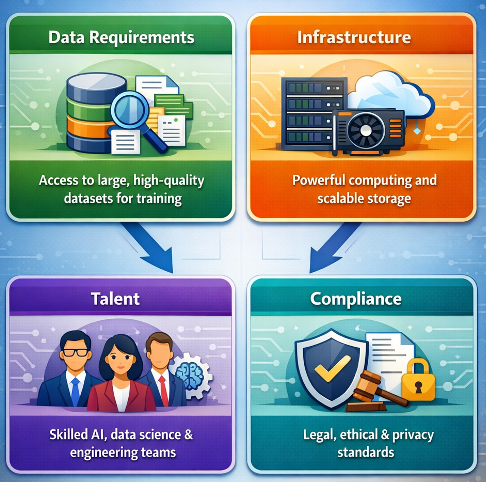
Figure: Key components in LLM/SLM development
Equally important is investing in the right talent. Developing and operationalising these models requires expertise spanning data science, software engineering, and domain knowledge. Organisations must focus on upskilling their current workforce or attracting professionals with hands-on experience in artificial intelligence and machine learning. Building and maintaining these models requires a blend of data science, engineering, and domain expertise. CXOs must invest in upskilling existing teams or acquiring talent with deep AI and ML experience.
Finally, the regulatory landscape cannot be overlooked. As governments worldwide introduce new frameworks around data privacy, security, and ethical AI use, it is imperative to weave compliance and ethical considerations into every phase of model development and deployment. By addressing these aspects thoughtfully, enterprises can ensure that their LLM or SLM initiatives are both impactful and sustainable in the long run. Regulatory landscapes are evolving rapidly. Data localisation, privacy laws, and ethical considerations must inform every stage of model development and deployment.
Decision Criteria to Choose SLM vs Private LLM
Selecting between Small Language Models (SLMs) and private Large Language Models (LLMs) hinges on a clear understanding of organisational priorities and operational constraints. Each approach brings distinct advantages, and the optimal choice will depend on factors such as scalability requirements, data privacy needs, performance expectations, and available resources.
Private LLMs are well-suited for enterprises aiming to tackle a diverse range of language-related tasks spanning multiple domains, offering the flexibility to adapt to changing business demands. On the other hand, SLMs excel in scenarios where speed, efficiency, and domain-specific accuracy are paramount, especially when resources or timeframes are limited. The decision-making process should also account for privacy considerations—private LLMs grant greater control over sensitive information, while SLMs’ lightweight architecture allows for secure deployment in isolated or on-premises environments.
The table below outlines the principal criteria to consider when deciding between SLMs and private LLMs:
| Criteria | SLM | Private LLM |
| Scalability | Best for targeted, well-defined applications where agility and rapid deployment are priorities. | Suited for large-scale, multi-domain environments requiring extensive language capabilities. |
| Privacy | Enables secure, on-premises deployment, minimising the risk of data exposure. | Offers enhanced oversight of data flows and model behaviour, ideal for sensitive sectors. |
| Performance | Delivers high efficiency and low latency for specific, custom tasks. | Ensures robust generalisation and adaptability, supporting varied business needs. |
| Cost & Time to Market | Involves lower investment and faster implementation, making it suitable for rapid rollouts. | Requires more substantial resources and longer timelines, but offers broader long-term value. |
To sum up the thoughts inline to this, the decision between SLMs and private LLMs should be guided by the organisation’s strategic objectives, regulatory landscape, and the nature of the tasks at hand. A careful evaluation of these criteria will enable leaders to make informed choices, ensuring their AI initiatives deliver maximum value while remaining compliant and sustainable.
Cost Implications
The financial outlay for LLM/SLM development must be approached holistically. Key cost drivers include:
- Development: Initial costs cover data acquisition, model selection, and customisation. LLMs incur higher costs due to scale and complexity.
- Training: Compute infrastructure (on-premises or cloud), energy consumption, and labour are significant. Training a high-quality LLM can run into crores of rupees.
- Deployment: Ongoing costs include hosting, monitoring, and scaling. SLMs can often be deployed with lighter infrastructure, reducing recurring expenses.
- Maintenance: Continuous model tuning, retraining, and compliance updates are necessary to ensure relevance and legal adherence.
Before all these, we should have a convincing reason on why we cannot use public LLM (due to compliance, industrial problem we address, data protection, hallucination in decision making to name a few) before we decide to develop a Private LLM or SLM.
Security Considerations
Security is paramount in LLM/SLM initiatives. Data privacy mandates, such as the Indian Data Protection Bill and international frameworks (GDPR, etc.), require robust data governance, encryption, and access controls. Model security involves protecting both the model and underlying data against adversarial attacks, data leakage, and misuse. Regular audits and compliance checks must be institutionalised, especially when models are deployed in regulated industries.
Monetization via ‘As a Service’ Model
The ‘as a service’ model presents significant monetisation opportunities. By offering LLM/SLM capabilities as APIs or platform services, organisations can unlock new revenue streams, scale usage dynamically, and serve a broader customer base. Key business models include:
- Subscription-based: Fixed monthly or annual fees for defined usage tiers.
- Pay-per-use: Charges based on the volume of API calls or processed data.
- Custom solutions: Bespoke model training, fine-tuning, and integration for enterprise clients.
The value proposition lies in accelerating customer innovation, reducing AI adoption barriers, and enabling rapid experimentation. Market opportunities are robust across verticals such as BFSI, healthcare, retail, and education.
CAPEX, OPEX, ABEX, and Cost Phasing
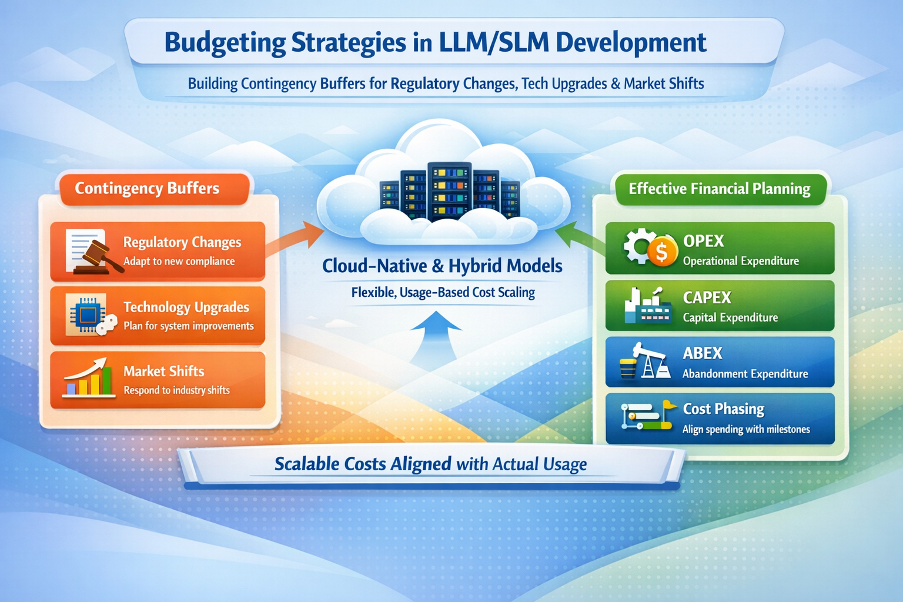
Effective financial planning is central to sustainable LLM/SLM investments. CXOs must consider:
- CAPEX (Capital Expenditure): Upfront investments in hardware, software licences, and core infrastructure. For private LLMs, this can be substantial, especially if on-premises GPUs/TPUs are required.
- OPEX (Operational Expenditure): Ongoing costs for cloud compute, maintenance, support, and talent. SLMs, with their lower resource requirements, can help optimise OPEX.
- ABEX (Abandonment Expenditure): In the journey of developing LLMs/SLMs, ABEX refers to the costs associated with discontinuing a project or decommissioning technology assets that are no longer viable or aligned with business objectives. These outlays might include the write-off of hardware and software, contract termination fees, or expenses linked to dismantling infrastructure and archiving data. ABEX is particularly relevant in the fast-evolving AI landscape, where pivots and strategic shifts are common as organisations respond to technological advances or changing market requirements.
ABEX stands apart from CAPEX (Capital Expenditure) in both timing and intent. While CAPEX involves upfront investments in physical assets, such as servers, GPUs, or proprietary software licences, which are expected to deliver long-term value, ABEX pertains to the financial impact when such assets are retired before their anticipated useful life. In essence, CAPEX is about building and enabling capabilities, whereas ABEX is about responsibly managing the costs of winding down or exiting investments that no longer serve the organisation’s strategic direction. Recognising and planning for ABEX helps CXOs mitigate financial risk and maintain agility as they navigate the complexities of AI adoption.
- Cost Phasing: Staggering investment over phases—proof of concept, pilot, and full-scale production—helps manage risk and aligns spend with value realisation. This phased approach also supports agility, enabling course correction based on early outcomes.
Budgeting strategies should include contingency buffers for regulatory changes, technology upgrades, and market shifts. Leveraging cloud-native or hybrid models can provide flexibility in scaling costs with actual usage.
Strategic Recommendations for CXOs
Investing in LLM and SLM development is a strategic lever for digital transformation. The choice between SLMs and private LLMs must be informed by business objectives, risk appetite, and resource availability. CXOs should make decisions based on following thinking points:
- Develop a clear AI strategy aligned with enterprise goals.
- Prioritise data governance, security, and compliance from the outset.
- Adopt a service-oriented approach to monetisation and scalability.
- Plan financial investments with a balanced view of CAPEX, OPEX, and ABEX, phasing spend to match value delivery.
- Foster a culture of continuous learning and innovation to stay ahead in the rapidly evolving AI landscape.
By addressing these considerations, CXOs can ensure that their LLM/SLM initiatives deliver sustainable business value, drive competitive differentiation, and position the organisation for long-term success in the AI-powered era.