

By Bala Kalavala, Chief Architect & Technology Evangelist
Introduction
In the evolving data landscape of 2026, the Open Lakehouse has transitioned from an emerging architectural pattern to the gold standard for enterprise data strategy. By merging the flexible, low-cost storage of a data lake with the high-performance management and ACID transactions of a data warehouse—all built on open-source standards—organizations are finally achieving a “single source of truth” that supports both BI and advanced AI workloads without vendor lock-in.
Open Lakehouse Architecture
The open lakehouse architecture represents a fundamental shift in data engineering by unifying the best attributes of data lakes and data warehouses into a single, cohesive system. In the past, organizations were forced to maintain two separate environments: a low-cost data lake for unstructured data and machine learning, and a rigid data warehouse for structured reporting and business intelligence. This fragmentation often led to data silos, expensive synchronization processes, and inconsistent metrics. The lakehouse solves this by implementing a metadata and transactional layer directly on top of open cloud storage. This allows high-performance SQL queries, ACID transactions, and schema enforcement to happen directly on the data lake, effectively turning a repository of files into a reliable database. By utilizing open standards, this architecture ensures that data is stored in a way that is accessible to a wide variety of processing engines, providing the agility to choose the best tool for a specific job without moving the data
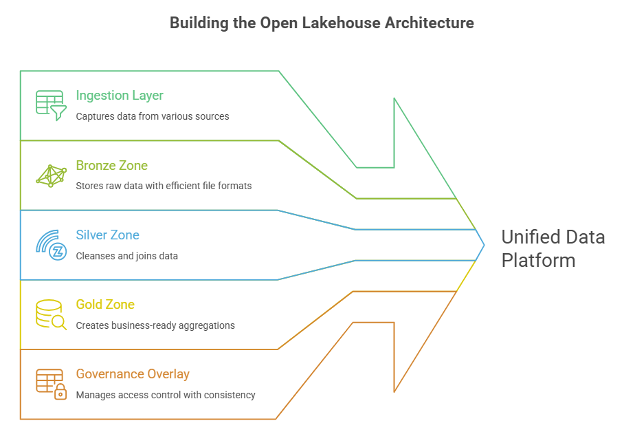
Diagram: Open Lakehouse Architecture for Unified Data Platform
The medallion architecture is the organizational framework used within a lakehouse to incrementally improve data quality as it flows through different stages of readiness. It begins with the bronze layer, which serves as the landing zone for raw, unvalidated data from source systems, often kept in its original format to provide a historical record. From there, data is processed and transformed into the silver layer, where it is cleansed, filtered, and joined to create a consistent view of the business domain. The silver layer is critical for data science and advanced analytics because it provides high-quality data without the restrictive aggregations found in final reports. Finally, the gold layer contains highly curated, aggregated data sets tailored for specific business use cases and executive dashboards. This tiered approach ensures that every persona in an organization, from the data engineer to the business analyst, has access to the data at the appropriate level of refinement while maintaining a clear lineage back to the raw source.
Open Lakehouse Reference Architecture with Open-Source
The reference architecture for an open lakehouse follows a multi-layered design that integrates various open-source technologies to handle data from ingestion to consumption.
Data Ingestion Layer: This entry point captures data from diverse sources, including operational databases, IoT devices, and SaaS applications. In an open architecture, tools like Apache Kafka or Debezium are used for real-time streaming and Change Data Capture (CDC), ensuring that data is moved efficiently into the lakehouse environment without being locked into a specific vendor’s ingestion tool.
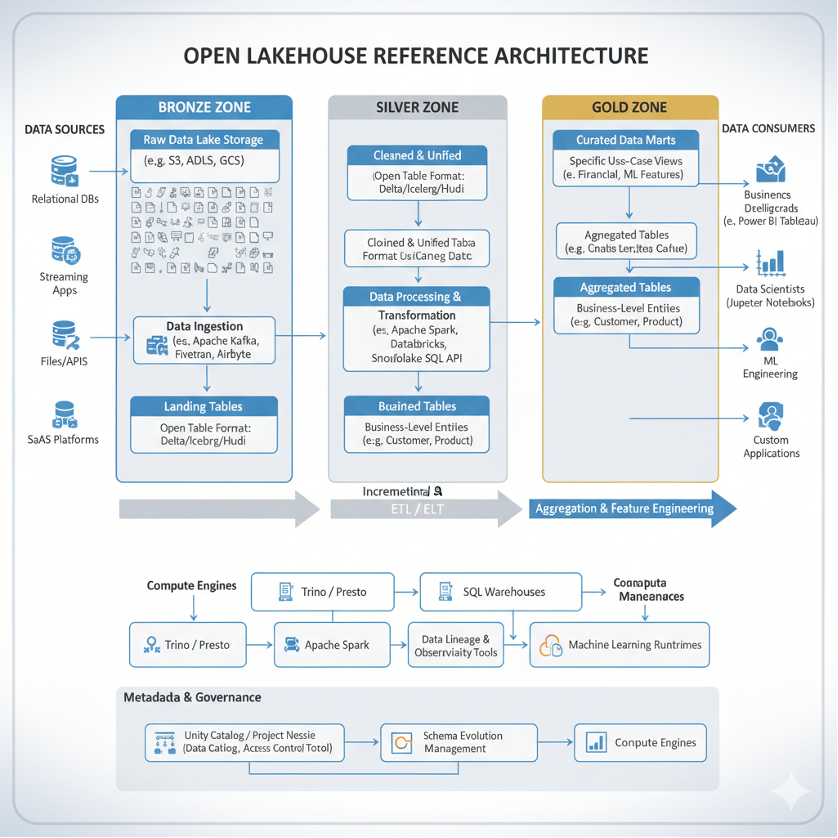
Diagram: Open Lakehouse Reference Architecture with Open-Source Ecosystem
Storage and Table Format Layer: This is the foundation where data is stored in high-performance, cost-effective object storage like MinIO or cloud-native S3-compatible buckets. The critical “lakehouse” functionality is provided by open table formats—Apache Iceberg, Delta Lake, or Apache Hudi—which sit on top of the storage. These formats manage metadata, enforce schemas, and provide ACID transactions, turning raw files into structured, reliable tables.
Governance and Metadata Layer: A unified catalog, such as Unity Catalog or Project Nessie, acts as the central brain of the architecture. It provides a single interface for managing access controls, data lineage, and auditing across all files and tables. This layer ensures that regardless of which compute engine is used, the security policies and data definitions remain consistent and enforceable.
Compute and Processing Layer: Multiple specialized engines access the same underlying storage simultaneously. Apache Spark is typically utilized for heavy-duty batch processing and machine learning, while Trino or Presto serves as the high-concurrency SQL engine for interactive analytics. Because the storage layer is open, these engines can be swapped or scaled independently based on the workload requirements.
Consumption Layer: The final layer serves refined data to end-user applications. Business intelligence tools (like Apache Superset), data science notebooks, and AI models consume the curated “Gold” tables directly from the query engines. This end-to-end flow ensures that the entire organization operates from a single, governed source of truth without the need for proprietary data silos.
An open-source lakehouse architecture relies on community-driven technologies to build this stack, ensuring the enterprise remains free from proprietary vendor lock-in. At the heart of this system are open table formats such as Apache Iceberg, Delta Lake, and Apache Hudi, which provide the critical transactional capabilities required for modern data management. These formats allow multiple compute engines, such as Apache Spark for heavy data processing and Trino for interactive SQL analytics, to work on the same underlying files simultaneously without corruption or performance bottlenecks. Metadata management and governance are handled by open-source tools such as Unity Catalog and Project Nessie, which provide unified security and data versioning, similar to how Git manages code. By integrating these open-source components, organizations can build a future-proof data platform that scales horizontally on commodity hardware or in the cloud, while maintaining complete control over their most valuable asset: their data. A successful open lakehouse is not a monolith but a layered ecosystem of specialized open-source tools.
| Tool Category | Open Source Tools | Key Strength in 2026 |
| Object Storage | MinIO, Ceph | High-speed S3 compatibility & data sovereignty |
| Table Format | Iceberg, Delta Lake, Hudi | ACID transactions & time-travel on open files |
| Query Engine | Trino, Presto, Dremio | Interactive SQL at scale; federated querying |
| Data Processing | Apache Spark, Apache Flink | Unified batch & stream processing for ML/AI |
| Cataloging | Unity Catalog, Nessie | Centralized governance & data version control |
Table: Open-Source Data Lakehouse software tools
Conclusion
The move toward an open Lakehouse is more than a technical upgrade; it is a strategic liberation. In 2026, organizations no longer accept being “locked in” to a single vendor’s proprietary format. By leveraging open-source components, businesses gain the agility to swap engines as technologies evolve, the scale to handle zettabytes of information, and the precision required for the next generation of Agentic AI. The open Lakehouse is not just a storage solution—it is the bedrock of a modern, intelligent enterprise.
References
- Apache IcebergTM : https://iceberg.apache.org/
- Build Lakehouse with Delta Lake: https://delta.io/
- Apache Spark – Unified engine for large-scale data analytics: https://spark.apache.org/
- Trino, a query engine that runs at ludicrous speed: https://trino.io/
The author is a seasoned technologist, enthusiastic about pragmatic business solutions and influencing thought leadership. He is a sought-after keynote speaker, evangelist, and tech blogger. He is also a digital transformation business development executive at a global technology consulting firm, an Angel investor, and a serial entrepreneur with an impressive track record.
The article expresses the author’s view, Bala Kalavala, a Chief Architect & Technology Evangelist, a digital transformation business development executive at a global technology consulting firm. The opinions expressed in this article are his own and do not necessarily reflect the views of his organization.