

Dr. Magesh Kasthuri
Cloud cost management has become an increasingly significant challenge for organisations transitioning from traditional IT to digital environments while migrating workloads to the cloud. The dynamic nature of cloud services, combined with complex consumption-based pricing models, often leads to unpredictable costs and limited transparency. In this environment, managing costs can be difficult due to non-linear pricing structures. Generative Artificial Intelligence (AI) and Agentic AI are beginning to reshape cloud financial operations (FinOps) by enabling more automated cost allocation and more efficient resource utilisation.
Generative AI and Agentic AI in FinOps
Generative AI, which can produce insights, recommendations, and solutions, has the potential to improve FinOps by automating analysis and supporting decision-making. Agentic AI extends this by enabling systems to act autonomously performing tasks, adapting to changing conditions, and responding to new information.
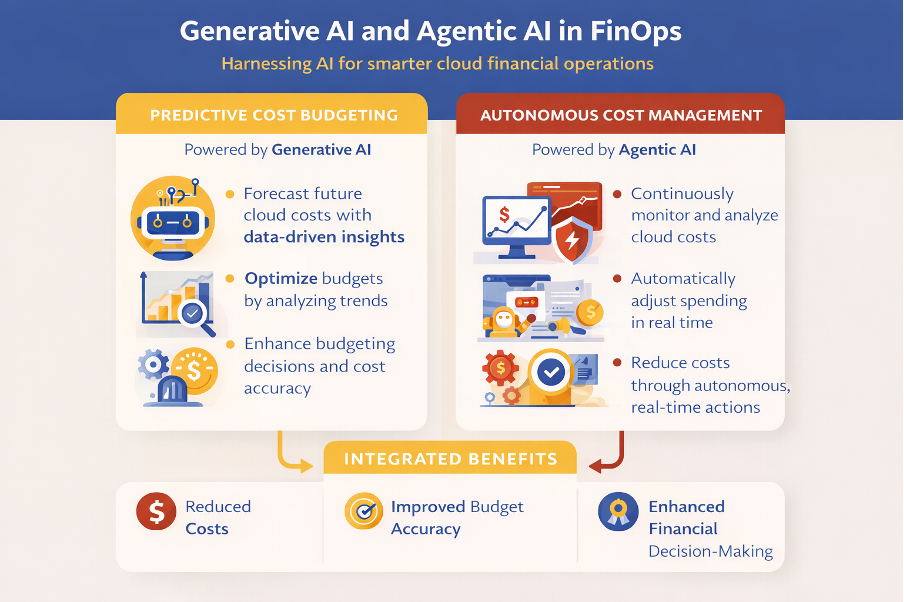
Together, these technologies allow organisations to move beyond reactive cost management toward more predictive and adaptive approaches. By leveraging machine learning, natural language processing, and real-time analytics, AI-enabled FinOps platforms can analyse large volumes of data, identify inefficiencies, and recommend or implement improvements with reduced manual intervention.
Autonomous Cost Management
Autonomous cost management represents a shift from periodic monitoring to continuous optimisation. AI-enabled systems can monitor cloud usage, analyse historical spending patterns, and detect inefficiencies or misconfigurations. These systems may recommend or automatically adjust resource allocations, terminate idle services, and optimise workloads to balance cost and performance.
By reducing reliance on manual monitoring, autonomous approaches can improve efficiency, support more consistent decision-making, and help organisations maintain greater financial discipline.
Predictive Cost Budgeting
Predictive cost budgeting is another emerging application of AI in FinOps. Using historical usage data and business trends, predictive models can estimate future cloud expenditures and simulate different consumption scenarios.
These systems can generate budget recommendations and alert stakeholders to potential overruns in advance. This proactive approach supports more effective resource planning, improves alignment between technical and financial goals, and can help organisations better manage spending variability.
FinOps Lifecycle Agents: Tagging, Sizing, and Reporting
The development of FinOps lifecycle agents reflects a practical application of Agentic AI in cloud cost management. Tagging agents can systematically label cloud resources so that services, instances, and workloads are associated with relevant business units or projects.

Figure: Reference architecture for FinOps agents
Consistent tagging helps prevent orphaned or underutilised resources from going unnoticed, improving cost visibility and accountability.
Sizing agents continuously analyse utilisation metrics to recommend more appropriate configurations for compute, storage, and network resources. This can help reduce over-provisioning and improve efficiency.
Reporting agents automate the generation of cost and usage reports, translating complex data into more accessible insights. These reports can support transparency, accountability, and more informed decision-making across the organisation.
Benefits and Future Outlook
The adoption of agentic and autonomous capabilities within FinOps offers several potential benefits. One key advantage is improved operational efficiency, as repetitive tasks such as tagging, cost allocation, anomaly detection, and reporting can be partially automated. This may reduce manual workload and lower the risk of human error.
Another benefit is enhanced cost visibility and control. Modern cloud platforms provide dashboards and tools that allow organisations to track spending across services, teams, and projects. With improved visibility, organisations can more easily identify underutilised resources and take corrective action.
Agentic FinOps approaches can also support more proactive financial planning. By using predictive analytics, organisations can model future consumption scenarios and assess the financial impact of growth, new initiatives, or infrastructure changes.
Looking ahead, FinOps practices are likely to become increasingly automated and integrated. Future architectures may include multiple coordinated agents that monitor, recommend, and implement optimisations across the cloud lifecycle. These systems may also integrate more closely with broader organisational processes, such as budgeting and project planning.
As AI capabilities continue to evolve, these systems may improve over time by learning from historical data and user feedback, helping organisations refine cost management strategies and align them with business objectives.
Conclusion
The convergence of Generative AI and Agentic AI is influencing how organisations approach cloud cost management. These technologies can support more automated optimisation, improved forecasting, and more structured lifecycle management.
By incorporating these approaches, organisations may be better positioned to address the complexities of cloud financial operations, improve efficiency, and align technology investments with broader business goals.
The future of FinOps is likely to involve more intelligent, adaptive systems that help organisations manage costs while maintaining flexibility and control in increasingly complex cloud environments.