

Introduction
In the era of digital transformation, organisations seek robust platforms to manage, analyse, and derive insights from vast and diverse data sources. Azure OneLake emerges as a unified data lake solution, offering seamless integration, scalability, and security for modern workloads. Particularly in the Banking, Financial Services, and Insurance (BFSI) sector, where data-driven decisions are paramount, OneLake provides a consolidated approach to data management, enabling real-time analytics and compliance.
Unified Data Lake Architecture
Azure OneLake is designed to simplify the complexities of data storage, access, and governance by unifying disparate data silos into a single logical lake. Its architecture comprises several key elements:
- Centralised Data Repository: OneLake stores structured, semi-structured, and unstructured data in a unified manner, supporting formats like Parquet, CSV, and JSON.
- Lakehouse Integration: The platform natively integrates with lakehouse paradigms, blending the strengths of data lakes and warehouses for both analytical and operational workloads.
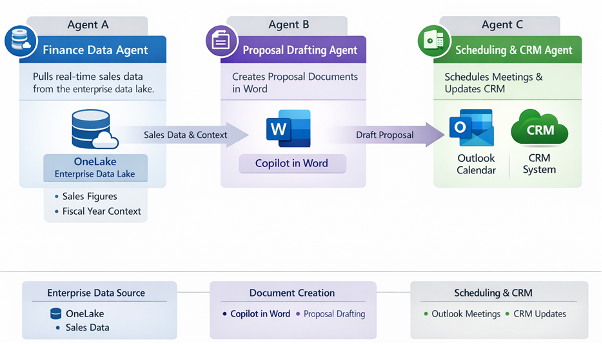
Figure: Azure One Lake agentic implementation
- Data Governance and Security: Built-in governance tools ensure data lineage, access control, and compliance, utilising Azure Purview and Active Directory.
- Multi-Platform Connectivity: OneLake connects seamlessly with Azure Synapse, Microsoft Fabric, Power BI, and third-party analytics tools, fostering interoperability.
- Real-Time Data Ingestion: Supports streaming and batch ingestion from sources such as databases, IoT devices, and external APIs.
Integration Capabilities
OneLake’s architecture is inherently flexible, allowing integration with legacy systems and modern cloud-native applications. Data can be ingested via Azure Data Factory pipelines, processed using Azure Synapse or Databricks, and visualised through Power BI. With built-in support for REST APIs and SDKs, developers can automate data operations and workflows efficiently.
BFSI Use Cases: Real-Time Examples
Banking: Fraud Detection and Transaction Analytics
Banks handle millions of transactions daily, making real-time fraud detection crucial. By ingesting transaction data into OneLake, machine learning models can analyse patterns to flag anomalies instantly. For example, a streaming pipeline using Azure Data Factory can push transaction logs to OneLake, where Synapse Analytics runs predictive algorithms to identify suspicious activity, triggering alerts for investigation.
Financial Services: Customer 360 and Risk Assessment
Financial institutions often require a holistic view of customer data for personalised services and risk evaluation. OneLake enables the consolidation of customer profiles, transaction histories, and external data feeds, facilitating advanced analytics. A practical scenario involves aggregating data from CRM systems, credit bureaus, and social media, then running risk models in Synapse to assess creditworthiness or offer tailored products. A reference architecture for this is shown in below diagram.
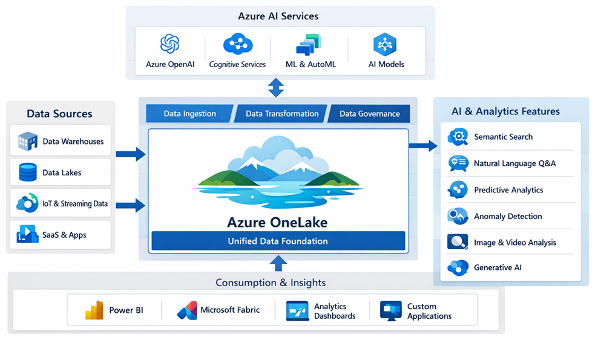
Figure: Unified Azure OneLake reference architecture
Insurance: Claims Processing and Regulatory Compliance
Insurance firms benefit from OneLake’s unified architecture to streamline claims processing and ensure compliance. Claims data, documents, and policy information are ingested and centralised, allowing automated validation and fraud checks. Additionally, regulatory reporting is simplified, as data lineage and access controls ensure only authorised personnel access sensitive information, meeting audit requirements.
Architectural Decisions and Design Considerations
- Scalability: OneLake is engineered for horizontal scaling, accommodating growing data volumes without performance degradation. Architects should design ingestion pipelines with partitioning and indexing strategies to optimise query speeds.
- Security: Leveraging Azure’s security framework, OneLake offers role-based access control, encryption at rest and in transit, and integration with Microsoft Defender. When designing the solution, consider granular permissions and audit trails to safeguard sensitive BFSI data.
- Cost Optimisation: With pay-as-you-go pricing, architects must balance storage and compute resources. Implementing data lifecycle policies, such as archiving infrequently accessed data, can significantly reduce costs.
- Performance: To ensure high throughput and low latency, utilise caching, data partitioning, and pre-aggregation techniques. Selecting appropriate file formats and compression options also enhances performance for analytical workloads.
- Compliance and Governance: The BFSI sector is highly regulated. Architects must ensure OneLake’s governance features, such as data cataloguing, lineage tracking, and policy enforcement, are configured to meet standards like GDPR, PCI DSS, and RBI guidelines.
Scripts and Code Examples
Data Ingestion Using Azure Data Factory
Below is a sample code snippet for ingesting banking transaction data into OneLake using Azure Data Factory pipeline:
{
“activities”: [
{
“name”: “CopyTransactionData”,
“type”: “Copy”,
“inputs”: [
{
“referenceName”: “SQLSource”,
“type”: “DatasetReference”
}
],
“outputs”: [
{
“referenceName”: “OneLakeSink”,
“type”: “DatasetReference”
}
],
“typeProperties”: {
“source”: {
“type”: “SqlSource”
},
“sink”: {
“type”: “AzureBlobSink”
}
}
}
]
}
Querying Data with Synapse Analytics
Example SQL query for fraud detection analysis:
SELECT transaction_id, customer_id, amount, location
FROM OneLake.Transactions
WHERE amount > 100000
AND location NOT IN (‘Customer_Home’, ‘Customer_Office’)
Access Control Configuration with Azure CLI
Setting up role-based access for compliance:
az storage account update \
–name onelakeaccount \
–resource-group BFSIResourceGroup \
–enable-hierarchical-namespace true \
–access-tier Hot
Conclusion
Azure OneLake is a centralized cloud-native data management platform for unified data lake architecture, empowering BFSI organisations to better harness the full potential of their data. Its integration, robust security, and scalable design facilitate real-time analytics and regulatory compliance. By thoughtfully considering architectural decisions around scalability, security, cost, and governance, IT architects and data professionals can optimise OneLake deployments for modern solutions. As the BFSI sector continues to evolve, leveraging platforms like OneLake will be pivotal in supporting operational analytics and governance objectives.