

By Rekha Kodali
The adoption of agentic AI does not fail primarily because of model limitations. It fails because enterprises attempt to operationalize autonomous behaviour without defining how agents communicate, access knowledge, and remain bounded by enterprise control systems.
Traditional application architectures assumed a clear separation:
application → service → database
Agentic systems fundamentally change this relationship.
An agent is not a single application component. It is a runtime decision entity that continuously interacts with tools, policies, memory, and other agents. Therefore, the enterprise must establish three supporting architectural capabilities:
- structured knowledge grounding
- governed agent communication
- controlled system execution
Without these, an agent becomes either unsafe (too much autonomy) or useless (too restricted to act).
Knowledge Grounding: RAG and CAG as Enterprise Memory Patterns
Large language models do not “know” enterprise data. They generate probabilistic responses. Therefore, reliable enterprise operation requires grounding mechanisms that connect agents to trusted information sources.
Retrieval-Augmented Generation (RAG)
RAG connects agents to trusted enterprise knowledge sources through indexed retrieval. Instead of answering from model memory, the system:
- Interprets user intent
- Retrieves relevant content from approved sources
- Augments context
- Generates a response
It integrates repositories such as policies, product catalogs, contracts, procedures, and case histories.
Architecturally, RAG serves as the enterprise knowledge access layer — replacing uncontrolled prompting with governed, evidence-based retrieval.
Shift:
Model-based answers → Evidence-based decisions
Context-Augmented Generation (CAG)
CAG injects structured runtime operational context directly into reasoning, including:
- Current transaction state
- Workflow stage
- User role
- Policy constraints
Where RAG provides knowledge, CAG provides situational awareness.
Together
RAG + CAG function as:
- Long-term memory (RAG) → Trusted enterprise knowledge
- Working memory (CAG) → Real-time operational context
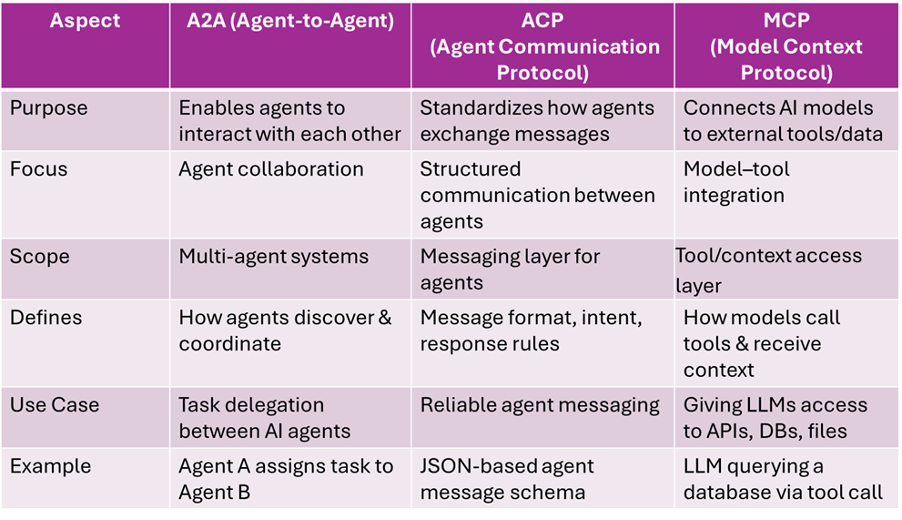
Agent Interoperability: A2A, ACP, and MCP
As organizations deploy multiple specialized agents, a new challenge appears:
agents must collaborate safely.
A claims processing agent, a fraud agent, and a payment agent cannot operate independently. They must exchange information without exposing internal systems or violating policies. This introduces the need for standardized communication and context protocols.
Given below are a set of Agent interoperability / invocation patterns:

Execution Control: From Suggestions to Actions
A critical architectural shift occurs when agents begin performing actions instead of generating recommendations.
At this stage, the enterprise must distinguish between:
information authority and operational authority.
An agent recommending a refund is low risk.
An agent issuing a refund is a financial transaction.
To manage this, agentic architecture introduces a controlled execution layer:
agent → tool abstraction → policy validation → system execution
The tool layer encapsulates APIs and enforces business rules.
The agent cannot directly perform system changes. It can only request actions.
This prevents unsafe automation while preserving autonomy.
Observability and Runtime Governance
Traditional software monitoring observes performance and availability.
Agentic systems require decision observability.
Enterprises must track:
- why a decision was made
- what data was used
- which agent participated
- confidence level
- human overrides
This enables:
- audit compliance
- model risk management
- operational trust
Agentic systems therefore require a new operational discipline: AI Operations (AIOps for reasoning systems), including behavior monitoring, drift detection, and decision review.
The Emerging Enterprise AI Stack
Emerging Enterprise AI Stack is not an extension of application architecture. It is a new operational architecture for digital workers.
The resulting architecture introduces a new enterprise layer between applications and data:
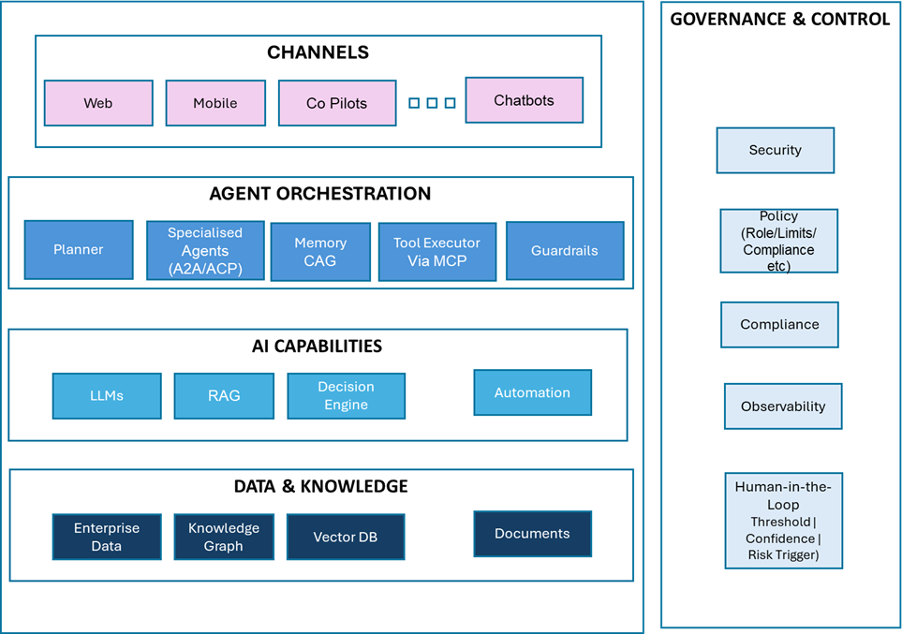
Let us go through some design patterns which can be leveraged in achieved the above architecture.
Design Patterns
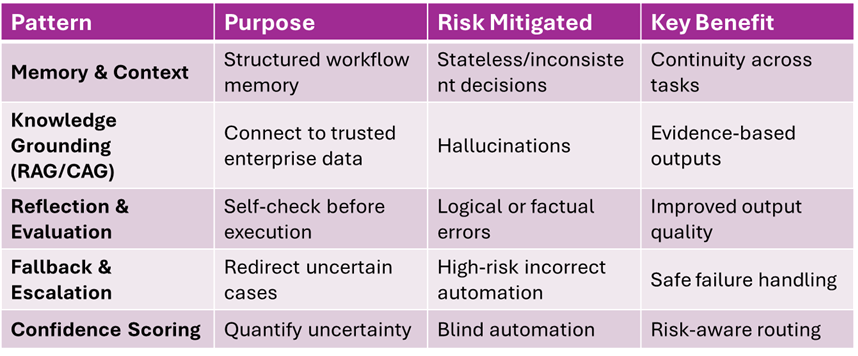
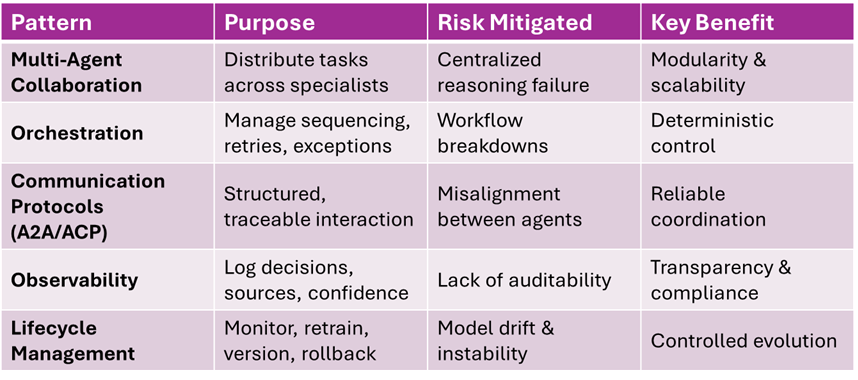
Agentic systems become dependable only when autonomy operates within defined structural boundaries. A core set of patterns establishes this structure.
Structural Control Patterns (Autonomy Within Boundaries): The planner–executor pattern separates reasoning from action so that interpretation of intent is independent from operational execution. The tool invocation pattern ensures agents do not directly manipulate enterprise systems but instead request governed services that enforce business rules and logging. Human-in-the-loop patterns introduce approval thresholds tied to financial impact, confidence level, or regulatory sensitivity, while policy and guardrail patterns embed operational constraints so that agents cannot exceed authority even when reasoning correctly. Together these patterns prevent a single model from becoming both decision maker and uncontrolled actor.

Information reliability and Situational awareness: A second group of patterns addresses information reliability and situational awareness. Memory and context patterns provide agents structured operational memory beyond a conversational window, enabling decisions based on current workflow state, user role, and policy conditions. Knowledge grounding patterns such as retrieval-augmented and context-augmented generation connect agents to trusted enterprise information and runtime context so outputs are evidence-based rather than inferred. Reflection and evaluation patterns allow agents to verify their own outputs before execution, while fallback and escalation patterns redirect uncertain or high-risk decisions to humans or deterministic workflows. These mechanisms convert probabilistic reasoning into controlled operational behavior.
Co ordination & Lifecycle Governance Patterns: The final group governs coordination and lifecycle management. Multi-agent collaboration patterns distribute complex processes across specialized agents rather than concentrating all reasoning in a single entity. Orchestration patterns manage sequencing, retries, and exception handling across workflows, while communication and context protocols ensure traceable interaction between agents and tools. Observability patterns record decision paths, data sources, and confidence levels, and lifecycle patterns address monitoring, retraining, rollback, and version control of agent behaviour. Collectively, these patterns create a repeatable operational contract so autonomous systems can scale consistently across business units without increasing enterprise risk.
Implication for Enterprise Architecture Teams
The role of enterprise architecture changes significantly.
Previously, architects designed integrations between systems.
Now they design interactions between decision-making entities.
The primary responsibility shifts from:
system integration → autonomy governance.
Key new responsibilities include:
- defining agent authority boundaries
- establishing approval thresholds
- designing knowledge access policies
- monitoring decision quality
- integrating risk and compliance into runtime operations
Closing Perspective
Agentic AI should not be viewed as a more capable chatbot.
It represents a transition similar to the introduction of service-oriented architecture or cloud computing — a change in how work itself is coordinated.
Enterprises are no longer only orchestrating applications.
They are beginning to orchestrate reasoning.
The architectural challenge is therefore not how to make AI smarter, but how to make autonomy dependable.
Organizations that invest in protocols, grounding, and governance will be able to deploy digital workers that operate safely alongside humans. Those that focus only on model capability will repeatedly encounter unpredictability, risk, and stalled adoption.
The future enterprise system will not consist solely of applications and users.
It will consist of humans and accountable autonomous actors working within the same operational framework.