

(Editor’s Note: This article represents part six of an ongoing series. Part one, “The Unavoidable ‘SCREAM’: Why Enterprise Architecture Must Transform for the Organization of Tomorrow” introduced the conceptual overview. Part two, “The Anatomy of SCREAM: A Perfect Storm in EA Cupboard“ detailed the current state of chaotic SCREAM. Part three, “The Co-Architect EA: Enterprise AARAM Through AI” detailed the aspirational future state of blissful AARAM. Part four, “TRIAL: Charting the Path from SCREAM to AARAM” highlighted the three-pronged bridge to AARAM. Part five, “BITS & BYTES: The Foundational Lens for Enterprise Transformation“ established the atomic language for architectural domains. This installment introduces WAR & PEACE—the second lens addressing the human and most important dimension of transformation.)
The Duality of Transformation
In the rapidly accelerating digital landscape, Enterprise Architecture (EA) faces formidable technological challenges, yet the most persistent systemic barrier remains organizational friction and cultural inertia. This systemic chaos, termed SCREAM (Situational Chaotic Realities of Enterprise Architecture Management), is primarily a human governance problem.1
W.A.R & P.E.A.C.E, the pivotal human lens within TRIAL, designed specifically to address this cultural challenge and shepherd the enterprise toward AARAM (Agentic AI Reinforced Architecture Maturities)2 with what I term “speed 3” transformation of AI.
The WAR & PEACE lens balances two interdependent forces:
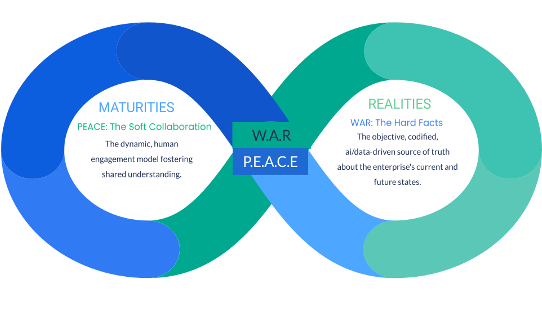
W.A.R: The Well-defined Architecture Repositories– the hard, constantly evolving repositories of codified truth about the enterprise’s current and future states.
P.E.A.C.E: Practicing Enterprise Architecture for Collaborative Execution (P.E.A.C.E.) – the soft, dynamic engagement model fostering shared understanding and continuous maturity.
Figure 1: WAR & PEACE Continuum: the organization shifts from fragile, people-dependent chaos to resilient, system-enabled harmony. This transformation operates through an interdependent cycle “Peace can only be brought through war, but war can only happen through peace”. This represents the Tolstoy-esque context: Yin and Yang in Enterprise Architecture.
The successful, continuous balancing of W.A.R. and P.E.A.C.E. is the biggest battle an Enterprise Architect must win. Just as Tolstoy explored the monumental scope of war against intimate moments of peace in his masterwork, the Enterprise Architect must balance the intense effort to build repositories against the delicate work of fostering organizational harmony.
- The Enduring Battle: Why Culture is EA’s Toughest Fight
Large organizations must manage complexity across strategic, tactical, and operational altitudes—yet hierarchical steepness and chronically misaligned priorities turn performance management into perception management. Executives see polished aggregates. Middle layers defend local optima. Ground realities never reach the top.
The organization begins to hallucinate its own reality of celebrations.
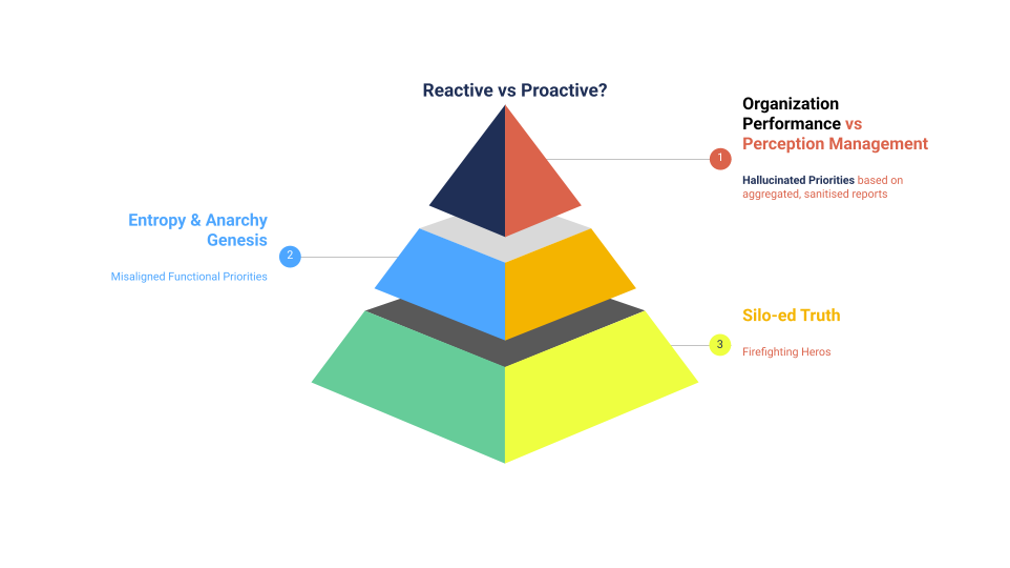
Figure 2: The Hallucinating Pyramid How hierarchical steepness and misaligned priorities turn performance management into perception management— complete with premature victories and green dashboards — while breeding entropy and anarchy below.
This is not a new problem — McKinsey and Gartner have been citing ~70 % transformation failure rates for a decade — but it is a persistent and worsening one.1419 Despite trillions spent, the cultural barrier has not improved; in many surveys it has actually hardened.
We observed the same pattern with the SaaS explosion of the 2010s: business users adopted hundreds of unsanctioned tools faster than IT could catalogue them, creating sprawling shadow IT ecosystems most leaders didn’t even know existed.
And now, with agentic AI solutions in the hands of business users — agents at loose — are we going to be silent witnesses to the exploding and amplifying anarchy at Speed 3?
Where this ends is anyone’s guess — but without a deliberate human lens, it ends in deeper SCREAM.
To win this battle against hallucination and anarchy, we need two complementary forces: objective truth (W.A.R.) and collaborative execution (P.E.A.C.E.)
II. The Well-defined Architecture Repositories (W.A.R.)
W.A.R. is the uncompromising source of truth. Codified, version-controlled, query-able.
Battle-ready characteristics:
- Single source of truth
- Granular BITS decomposition – Organizing across Business, Information, Technology, and Security domains—the atomic language
- Automated ingestion via scanners, CI/CD, and agentic AI
- Governance by Design: Every artifact traces to a BYTES guardrail (Balanced, Yearly, Transformation, Enhancing, Services) and a business outcome
- Version control and audit trails: For all architectural decisions, enabling true impact analysis and change management.
A strong W.A.R. kills anarchy. Facts become undeniable. Shadow IT — and now shadow AI — dies of embarrassment.
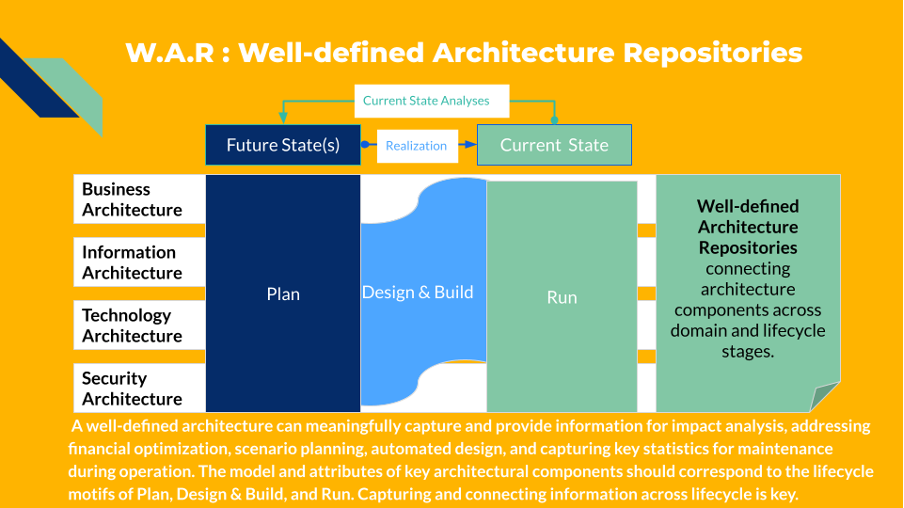
Figure 3: Well-Defined Architecture: a significant effort—a true “war size effort”—is required to establish and maintain this repository for a complex enterprise. The architecture definition within W.A.R. must be grounded in the organization’s current state of maturity
The W.A.R. systematically organizes information across the four critical architectural domains defined in our previous article: Business, Information, Technology, and Security (BITS). The true power of W.A.R. lies in its ability to associate technical components with measurable business and financial properties, effectively transforming technical discussions into measurable, strategic imperatives. Each architectural components across BITS are tracked across Plan, Design & Run lifecycle of change under the guardrails of BYTES.
The true constitution that governs the entire Agentic Enterprise Continuum is the enterprise’s Motivation layer: (Vision → Goals → Objectives) → (Mission → Strategies → Tactics.)
This Ends/Means model is the non-negotiable contract. Every proposed BITS change must first be Balanced — it must trace to at least one Tactic, and every Tactic must serve a measurable Objective.
The Plan-Design-Run cycle then pulls only the approved components, with strategic planning always the first driver.
This collection of quantified, objective data is what arms the EA to operate as a strategic partner. It provides the empirical evidence needed to dismantle outdated processes, debunk organizational myths, and secure stakeholder alignment—acting as a crucial weapon against cultural resistance.
III. Practicing Enterprise Architecture for Collaborative Execution (P.E.A.C.E.)
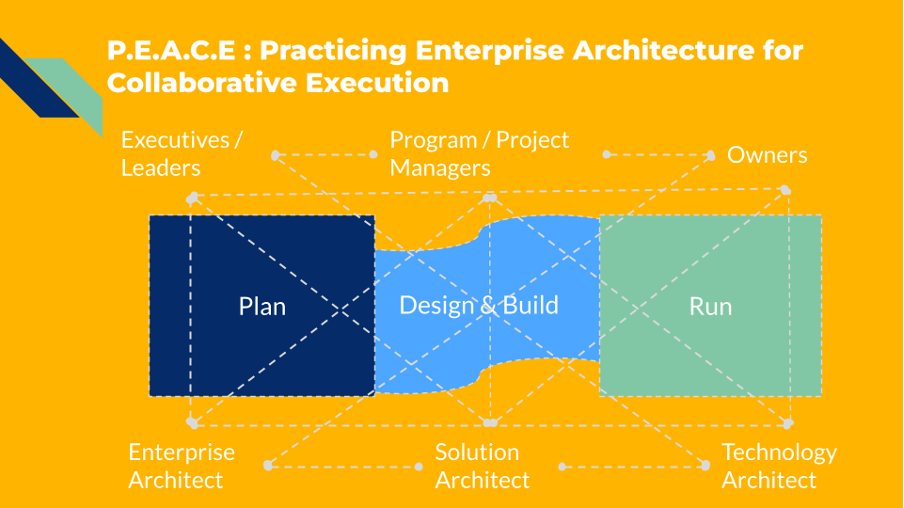
Figure 4: P.E.A.C.E Collaborative Execution Model provides the detailed operational view.
Collaborative planning and execution by breaking barriers using information to right stakeholders in right context. This would further be enabled by mapping process/architecture (based on maturity) and point of view (based on use cases) to enable speedy value to business stakeholders.
Achieving effective P.E.A.C.E. mandates a carefully constructed collaborative environment where diverse organizational roles work together toward a shared objective. This requires alignment across all lifecycle stages using social capital and intelligence.
By capturing the high-level vision together with on-the-ground reality, Enterprise Architects can break down those notorious ‘ivory tower’ walls and work on architecture that delivers a deeper business impact.
P.E.A.C.E. wins through ritual: joint road-mapping, architecture councils, decision logs tied to W.A.R., and agentic AI views tailored to each stakeholder’s language.
The EA of tomorrow must master both hard and soft domains: deep and wide technical competencies combined with collaborative skills to neutralize politics with facts while managing the utopia fallacy of unrealistic expectations.
One wise man once told me EA should never lead with a tool, but time has come that to foster interdependence between human wisdom and systematic guidance.
IV. The Eternal Cycle: The Agentic Enterprise Continuum
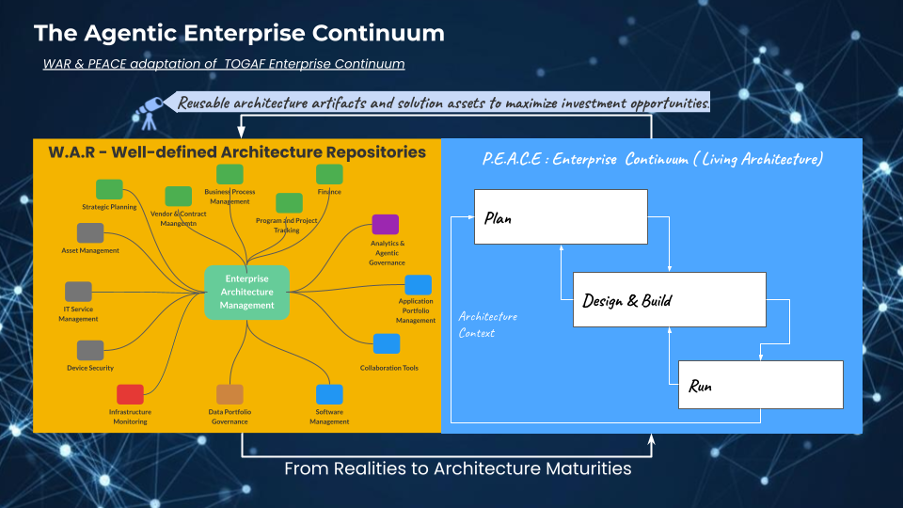
Figure 5: Agentic Enterprise Continuum –an adaptation of TOGAF’s Enterprise Continuum that finally closes the 30-year gap between repository and practice.20 The cycle never ends, but every revolution shrinks cultural resistance and raises architecture maturity based on prioritized business outcomes.
The effectiveness of EA relies heavily on it being a continuous, living practice—the Enterprise Continuum—rather than a singular, static blueprint. Therefore, continuously improving the well-defined architecture repositories throughout the collaborative execution journey is an absolute imperative for driving systematic maturity. This dynamic tension sustains adaptive, agile capability.
Conclusion & Call to Action
The greatest fight in Enterprise Architecture is not against technology—it is against entropy and anarchy rooted in human behaviour. WAR & PEACE gives us the weapons: an unforgiving repository of truth and an unrelenting practice of collaborative execution.
When these forces are in dynamic balance, culture stops blocking and starts accelerating.
We are building the new standard together. Test it, break it, improve it. Reach out on LinkedIn or through the magazine—the working group is open.
Only by winning this battle can we silence the SCREAM and step confidently into AARAM.
From Realities to Architecture Maturities—the journey continues.
Next: HUB & SPOKE — detailing the HOW, mechanism to achieve incremental AARAM and the final TRIAL lens.
References
1 Previous installments in this series, Architecture & Governance Magazine
14 McKinsey & Company, “How to beat the transformation odds,” ongoing research (70 % figure reaffirmed in 2023–2025 surveys)
19 Gartner, “Only 48 % of digital initiatives meet/exceed targets,” October 2024; culture remains the #1 barrier in 2025 surveys
20 The Open Group, TOGAF® Standard, 10th Edition, 2022
Next: Hub & Spoke — exploding the collaboration model and the final TRIAL lens.