

By Dr. Magesh Kasthuri
Enterprises are entering a phase where artificial intelligence agents are no longer treated as isolated experiments or productivity add-ons. They are becoming reusable digital capabilities that can be discovered, governed, deployed, measured, and improved like enterprise software products. This shift is especially important in large technology organizations where software delivery, product delivery, and operations are spread across many teams, tools, platforms, and business units. An Enterprise Agent Marketplace provides the structure required to turn scattered agent pilots into a controlled ecosystem of reusable agents, agentic workflows, prompt assets, tool connectors, evaluation packs, and governance patterns. When combined with a Client Zero strategy, the marketplace becomes more than a catalog. It becomes a living proof point that the enterprise has tested its own agentic operating model on itself before taking it to clients or business stakeholders.

Figure 1: Agent Marketplace driven by Client Zero Concept
As shown in above figure, the idea of Client Zero is simple but powerful. The enterprise becomes its own first customer. Instead of presenting agentic AI as a promise, it applies the same architecture, controls, adoption model, and operating discipline internally. The organization learns from real users, real enterprise data, real security boundaries, real approval workflows, and real production constraints. This creates a more credible and mature path for scaling agents across software development lifecycle activities, product delivery lifecycle acceleration, and IT service management operations. It also prevents the common mistake of treating agents as clever demonstrations that work well in controlled conditions but struggle when exposed to enterprise complexity.
Enterprise Agent Marketplace as a Strategic Capability
An Enterprise Agent Marketplace is a governed environment where teams can publish, discover, assess, reuse, deploy, and retire agents. It resembles an internal application marketplace, but the assets listed in it behave differently from conventional applications. A traditional application usually exposes fixed functionality. An agent interprets goals, reasons over context, invokes tools, coordinates steps, and may act on enterprise systems within defined guardrails. Because of this difference, an agent marketplace must include capability metadata, ownership details, access policies, supported toolchains, data boundaries, evaluation scores, release status, usage metrics, cost profiles, and human approval requirements. The marketplace should make every agent understandable before it is used, observable while it is running, and accountable after it completes a task.
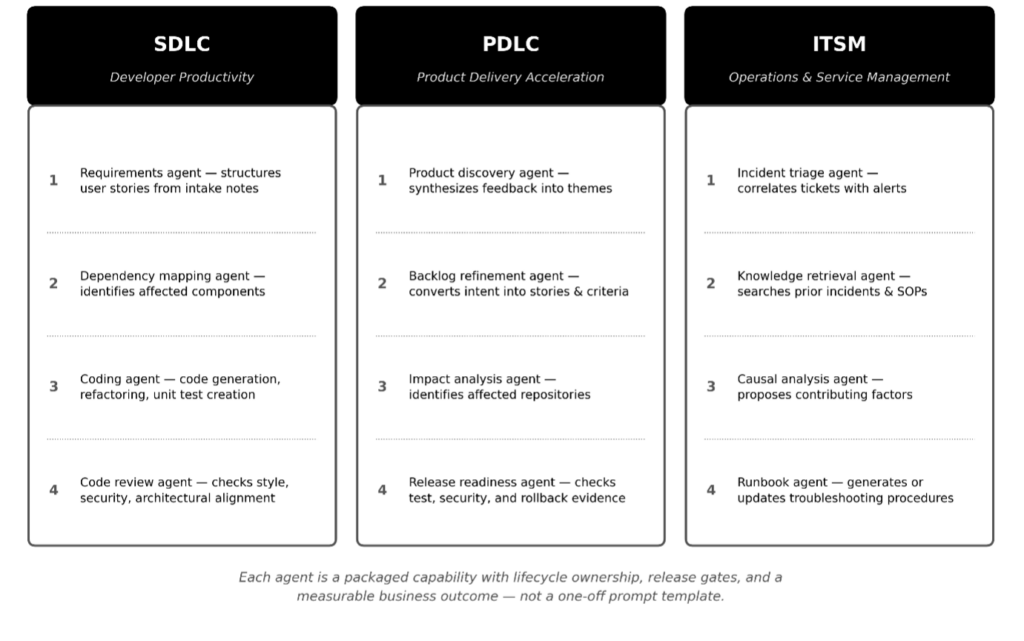
Figure 2: Agents across SDLC, PDLC and ITSM services
At enterprise level, the marketplace should organize agents as products rather than scripts as shown in above figure. Each agent needs a defined purpose, a published input and output contract, a list of approved tools, a security model, a version history, and a measurable business outcome. In a mature marketplace, a code review agent, a user story generation agent, an incident triage agent, and a change request preparation agent are not merely prompt templates. They are packaged capabilities with lifecycle ownership, release gates, quality benchmarks, and operational support expectations. This productization discipline is what makes reuse possible across portfolios. Without it, every project team builds its own variation, causing duplication, inconsistent quality, fragmented governance, and unnecessary token or infrastructure consumption.
Agents for SDLC: Improving Developer Productivity
In the software development lifecycle, agents create value by reducing friction around analysis, design, development, testing, and release preparation. The most effective SDLC agents do not replace developers; they remove repetitive cognitive load so that developers can focus on architectural judgment, business logic, engineering trade-offs, and secure implementation. A requirements agent can summarize intake documents, meeting notes, and backlog descriptions into structured user stories. A dependency mapping agent can examine related stories, repositories, API contracts, and configuration data to identify affected components. A design support agent can draft architecture decision records, review non-functional requirements, and suggest patterns that align with enterprise reference architecture. These agents help teams move faster while preserving traceability from requirement to design and from design to implementation.
For developers, coding agents can support code generation, refactoring, code explanation, unit test creation, build issue diagnosis, and pull request preparation. In a modernization factory, for example, a Java upgrade agent may inspect the repository, identify deprecated dependencies, propose migration changes, run build checks, and prepare a pull request with evidence. A code review agent can examine the generated changes for style, security, maintainability, and architectural alignment before a human reviewer performs the final assessment. A local build agent can reproduce build failures and recommend fixes. The productivity gain does not come from one spectacular act of automation; it comes from compressing dozens of small handoffs that usually slow teams down across sprints.
Agents for PDLC: Accelerating Product Delivery
The product delivery lifecycle extends beyond coding. It includes ideation, discovery, product planning, backlog refinement, solution shaping, engineering delivery, acceptance, rollout, feedback, and continuous improvement. Agents can accelerate PDLC by connecting these stages with better context and fewer manual transitions. A product discovery agent can synthesize customer feedback, support tickets, analytics observations, and stakeholder inputs into themes. A backlog refinement agent can convert product intent into well-structured epics, features, stories, acceptance criteria, and risks. A release readiness agent can assess whether requirements, design documents, test evidence, security approvals, deployment plans, and rollback instructions are complete before promotion to higher environments.
Consider a product team working on a technology currency initiative, such as browser compatibility, framework patching, or a security library upgrade across many applications. In a traditional model, each team analyzes the change, prepares stories, identifies affected code, updates build pipelines, runs test suites, raises change requests, and coordinates deployment. Through a marketplace-driven agentic pattern, the same work can be expressed as an archetype: an intake agent qualifies the item, an impact analysis agent identifies affected repositories, a remediation agent implements prescribed changes, a testing agent runs regression evidence, and a change management agent prepares release documentation. Human checkpoints remain in place for design acceptance, production approval, and exception handling, but the delivery flow becomes more repeatable and less dependent on manual orchestration.
Agents for ITSM: Reimagining Operations and Service Management
In IT service management, agents can transform operations from reactive ticket handling to proactive, predictive, and experience-oriented service delivery. ITSM agents can classify incidents, enrich tickets, search knowledge bases, recommend standard operating procedures, correlate similar incidents, generate root cause hypotheses, prepare change requests, and initiate approved remediation workflows. Many service desks still depend on manual triage and fragmented knowledge. An incident triage agent can read the ticket description, correlate it with monitoring alerts, search prior incidents, map it to known configuration items, and recommend the next action. When the issue is routine, the agent may trigger a self-healing workflow. When the issue is complex or business critical, it can escalate with a richer diagnostic package for the support engineer.
A production operations example illustrates the difference. Suppose an application experiences intermittent latency in a business-critical transaction. A conventional support process may require separate engineers to inspect logs, review monitoring dashboards, check recent deployments, and search past incidents. An operations insight agent can correlate telemetry from observability tools, recent change records, infrastructure events, and user experience signals. A causal analysis agent can propose likely contributing factors, while a runbook agent can generate or update the troubleshooting procedure. The support engineer remains accountable for judgment and approval, but the time spent gathering context is drastically reduced. Over time, the marketplace captures these agents as reusable operations capabilities, improving response consistency across towers and accounts.
Lifecycle for Developing Production-Grade Agents
Developing production-grade agents requires a disciplined lifecycle that is closer to product engineering than prompt experimentation. The first stage is opportunity discovery and problem framing. Teams identify high-value workflows where an agent can reduce cycle time, improve quality, lower operational effort, or strengthen compliance. This stage requires more than enthusiasm for automation. The team must define the business problem, current pain points, target users, decision boundaries, success metrics, data availability, tool access, risk level, and failure impact. A good candidate is usually a workflow with clear inputs, repeatable actions, measurable outcomes, and known escalation paths.
Figure: Lifecycle of developing Production grade Agents
The second stage is agent design and architecture. Here the team defines the agent’s role, autonomy level, tool permissions, memory strategy, knowledge sources, integration model, orchestration pattern, fallback behavior, and human-in-the-loop controls. If the agent participates in a multi-agent workflow, the team also defines handoffs, state management, conflict resolution, and shared context. For an SDLC modernization archetype, the design may include a Jira intake agent, a repository analysis agent, a remediation agent, a test generation agent, and a pull request agent. For ITSM, the design may combine a ticket enrichment agent, a knowledge retrieval agent, a causal analysis agent, and an auto-remediation agent. The architecture must be explicit because production agents act across systems that carry security, compliance, cost, and service reliability implications.
The third stage is build and integration. Developers construct the agent using approved models, prompt patterns, tool connectors, retrieval pipelines, APIs, policy checks, and workflow services. Secure integration is critical at this stage. Agents should not receive broad access merely because they are convenient. They should operate with least privilege, use enterprise identity controls, respect data classification rules, and record tool invocations for audit. If Model Context Protocol servers or API gateways are used, they should enforce authentication, authorization, throttling, schema validation, and logging. The agent should also be designed for cost efficiency, with context management, token budgeting, caching where appropriate, and model selection based on task complexity.
The fourth stage is evaluation and validation. A production-grade agent must be tested not only for response quality but also for task completion, factual grounding, policy compliance, tool selection, exception handling, latency, cost, and resilience. Offline evaluation uses curated datasets, golden answers, adversarial prompts, and regression suites to compare agent versions before release. Online evaluation monitors real usage under controlled rollout. For example, a code remediation agent should be evaluated against build success, test pass rate, security scan results, review comments, and rollback frequency. An incident agent should be evaluated against triage accuracy, mean time to acknowledge, mean time to resolve, escalation quality, and user satisfaction. Without measurable evaluation, confidence remains anecdotal.
The fifth stage is controlled deployment. Agents should move through environments in the same disciplined manner as enterprise software. A sandbox validates early behavior, a pilot exposes the agent to selected users and bounded workflows, a limited production release introduces operational monitoring, and enterprise rollout happens only after adoption, risk, and reliability conditions are met. Release gates should cover security approval, data approval, model evaluation, prompt versioning, tool access review, human approval design, rollback procedures, and support readiness. A marketplace listing should clearly show whether an agent is experimental, pilot-ready, production-approved, deprecated, or retired.
The final stage is AgentOps and continuous improvement. Once deployed, agents need monitoring, incident management, feedback loops, drift detection, cost analysis, and periodic re-certification. AgentOps captures execution traces, prompts, retrieved context, model calls, tool invocations, approvals, exceptions, outputs, latency, and cost. This evidence allows teams to explain decisions, reproduce failures, compare versions, and improve reliability. Continuous improvement also depends on marketplace analytics. Usage patterns show which agents deliver value, which ones require tuning, and which ones should be retired. A production-grade agent is therefore never a one-time artifact. It is an enterprise asset that must be owned, measured, refreshed, and governed throughout its life.
Benefits of the Client Zero Strategy
A Client Zero strategy gives the enterprise a practical way to build trust before scaling. By using its own delivery teams, operations teams, architects, engineers, and service managers as the first users, the organization uncovers the practical challenges that do not appear in a slide deck. It learns where data quality is weak, where knowledge is outdated, where tool access is fragmented, where human approval is still necessary, and where the agent experience needs redesign. These lessons improve the marketplace before it is exposed broadly. The strategy also creates authentic proof points. Instead of claiming that agents can reduce delivery cycle time or improve service resolution, the enterprise can show evidence from its own SDLC, PDLC, and ITSM workflows.
Client Zero also improves adoption because the marketplace is shaped by real practitioners rather than by a central team working in isolation. Developers can influence IDE integration, pull request workflows, build diagnostics, and test evidence capture. Product owners can refine how agents convert discovery inputs into stories and acceptance criteria. Service managers can validate incident classification, runbook generation, change evidence, and escalation rules. Security and governance teams can inspect how identity, audit, data access, and approval controls work in practice. This creates a community of evidence-based adoption, where champions emerge from delivery and operations rather than from mandate alone.
The strategy further strengthens reuse and economics. When internal teams use the marketplace first, duplicate agents are easier to identify, common archetypes are easier to standardize, and token consumption can be measured before broad rollout. A Java upgrade agent, a vulnerability remediation agent, or an incident pattern analysis agent can be refined through repeated internal use until it becomes a dependable building block. Marketplace governance can then promote the agent from pilot to production, publish guidance for appropriate usage, and define the ownership model. This reduces the risk of uncontrolled agent sprawl and creates a more predictable path from experimentation to enterprise scale.
Operating Model for an Enterprise Agent Marketplace
A marketplace needs an operating model that balances innovation with control. The typical structure includes an AI platform team that provides engineering foundations, an AgentOps team that defines observability and reliability practices, domain teams that own agent requirements and business outcomes, security teams that approve access and policy controls, and adoption teams that drive enablement. The marketplace should also include a review board or governance forum that evaluates new submissions, approves production promotion, reviews risk exceptions, and monitors retirement decisions. This governance should not become a bottleneck. Its purpose is to make safe reuse faster by providing reusable patterns, templates, evaluation packs, and approved connectors.
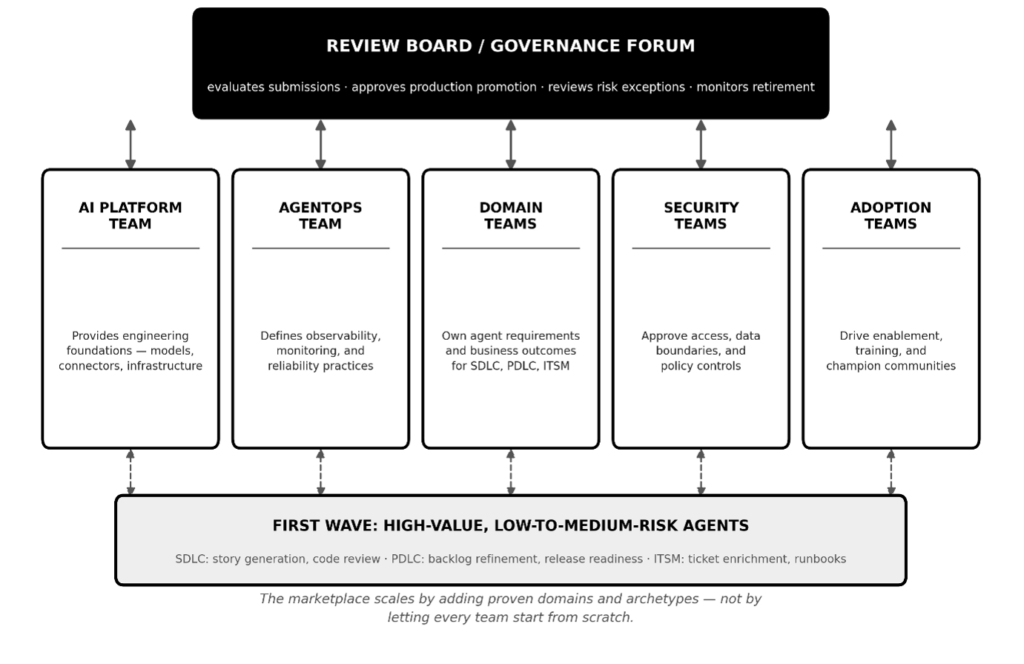
Figure 4: Operating model for the Enterprise Agent Marketplace
The first implementation wave should focus on a small number of high-value, low-to-medium-risk agents. In SDLC, this may include user story generation, code review assistance, unit test generation, and build issue diagnosis. In PDLC, it may include backlog refinement, traceability checks, release readiness assessment, and dependency analysis. In ITSM, it may include ticket enrichment, knowledge retrieval, incident pattern analysis, and runbook generation. Once these agents prove value under Client Zero usage, the enterprise can package them into archetypes that represent repeatable workflows, such as technology currency remediation, vulnerability fix automation, release evidence preparation, or incident-to-problem analysis. The marketplace then scales by adding more domains, not by encouraging every team to start from scratch.
Conclusion
Developing an Enterprise Agent Marketplace with a Client Zero strategy is a practical approach to scaling agentic AI responsibly. It recognizes that production-grade agents require more than model access and prompt engineering. They require clear ownership, secure integration, lifecycle discipline, measurable evaluation, operational observability, and continuous improvement. For SDLC, the marketplace improves developer productivity by reducing repetitive engineering effort and strengthening traceability. For PDLC, it accelerates product delivery by connecting ideation, backlog, engineering, validation, and release readiness. For ITSM, it modernizes operations by enabling faster triage, richer diagnostics, better knowledge reuse, and more proactive service management.
The strongest value of Client Zero is that it turns internal experience into enterprise confidence. The organization learns by doing, improves through operational evidence, and scales only after its own users have tested the marketplace under real conditions. This makes the marketplace credible, repeatable, and commercially meaningful. In the long run, the winning enterprises will not be those that create the largest number of agents, but those that build a trusted system for discovering, governing, operating, and improving agents as reusable digital assets.