

Dr. Gopala Krishna Behara & Narumanchi Sree Keerthi
AI is evolving from predictive models to autonomous, goal-driven systems. To stay relevant, it’s essential to understand how AI, GenAI, AI Agents and Agentic AI are connected and its future.
Agentic AI simply generates content or responds to prompts, toward autonomous digital entities that perceive context, reason through complexity, plan multi‑step actions, and execute tasks across systems.
Unlike traditional automation or conversational AI, Agentic AI operates with autonomy, adaptability, and self‑improving behavior, making it a transformative force for modern enterprises.
Latest views on Agentic AI adoption by Industry Leaders are:
- Agents will replace traditional app workflows – Google
- Multi-agent systems will become standard in enterprises – NVIDIA
- Governance, safety, and orchestration are the biggest adoption challenges-Microsoft
- Cross system autonomy is the key enterprise requirement-Open AI
- Agents will act, not just answer-AWS
- Every company will run thousands of agents-Meta
This paper covers the industry adoption of Agentic AI technology, characteristics of Agentic AI, when to adopt Agentic AI and When not to use Agentic AI. It also covers Agentic AI Frameworks and the comparison with Agentic AI Platforms.
Basic AI Types: Key Terms
AI & ML: It is a technique that enables machines to mimic human behavior and cognitive abilities. It includes Machine Learning. ML uses statistical methods to improve tasks with past experiences. It includes deep learning. DL uses neural networks to train machines to perform tasks. It is composed of multiple layers of interconnected nodes and is used for tasks such as image and speech recognition. It includes Generative AI.
Neural Networks: Machine Learning algorithms that are modeled after the human brain. It consists of layers of interconnected neurons that are used to process and analyze data.
Generative AI: It is a set of models that describe what we want, visualizing and generating content to match prompts. Generative AI accelerates ideation, brings vision to life and frees up spending more time on being creative. It creates a wide variety of data such as images, videos, audio, text and 3D models. Typically uses Large language models, for example: ChatGPT, OpenAI. LLM is Generative AI algorithm that uses deep learning techniques and huge datasets to generate and predict new content.
AI Agents: An AI agent is a software application that engages with its surroundings, collects information, and utilizes that data to accomplish predefined objectives. AI Agents are,
- Software programs that perform tasks autonomously or semi- autonomously
- Runs independently to design, execute, and optimize workflows
- Guardrails can be built into AI agents to help ensure they execute tasks
correctly - Powerful tool for driving better decision-making and operational efficiency
- Personalization
- Perform tasks with high precision and consistency
- Manage and optimize complex systems
- Monitor and analyze security threats in real time, providing proactive measures to prevent breaches and ensure data protection
- Increase productivity by reasoning, planning, and self-checking, releasing users from certain tasks
Agentic AI: Agentic AI is a type of AI solution that can act on its own without human control to achieve goals, make decisions, take actions and adapt to its environment. It operates with a degree of independence, pursuing objectives with minimal human intervention.

Fig 1: Evolution of Intelligence: From Machine Learning to Agentic AI
Industry Trends of Agentic AI
- By 2028, a significant increase in AI agent adoption across various industries- Gartner
- By 2027, nearly 15% of new applications will be automatically generated by AI without a human in the loop. This is not happening at all today – Gartner
- Recent CEO surveys show almost 80% of CEOs believe AI is likely to significantly enhance business efficiencies in their organization – Forbes
- According to Deloitte survey, 42% of organizations already cite tangible benefits from AI agents
- AI agents will lead to a flattening of organizational structures, with up to 20% of organizations eliminating middle management positions by 2026- Gartner
- AI adoption increased from 50% to 72% and highlight the potential of AI agents to improve business operations – McKinsey
- By 2029, agentic AI will autonomously resolve 80%of common customer service issues without human intervention, leading to a 30% reduction in operational costs – Gartner
- By 2028, agentic AI will be responsible for making 15% of everyday work decisions – Forbes
Key Characteristics of Agentic AI
Agentic AI systems plan, decide, act, and learn—fundamentally different from conversational or generative AI because they don’t just produce responses; they autonomously execute tasks and drive outcomes across systems. The various steps involved are Perception, Reasoning, Planning, Action and Reflection.
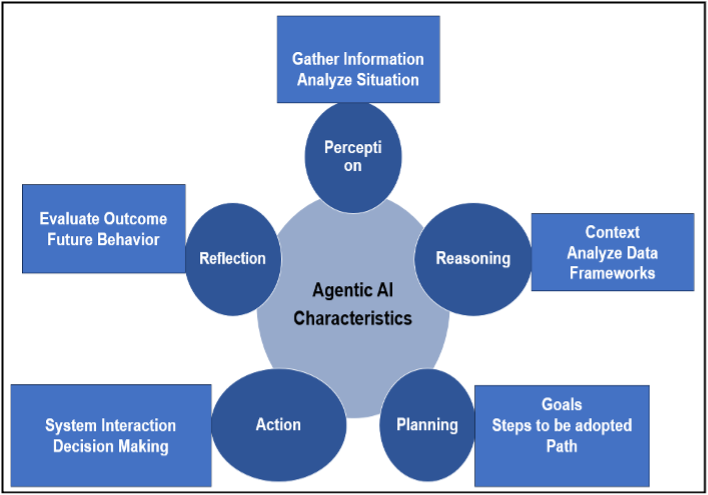
Fig 2: Agentic AI Characteristics
The below section briefly describes each step with an example of “Claims Management” of Health Care domain.
Perception: Agentic AI gathers situation information from its surroundings and different sources like sensors, databases, and user/digital interfaces. This involves analyzing text, images, or other forms of data to understand the situation.
As an example in Claims Management, an agent receives a new inpatient claim and automatically extracts data from:
- Claim form (diagnosis, procedure codes, modifiers)
- Attached clinical notes (PDFs, faxes, EHR extracts)
- Member eligibility system
- Provider directory
- Prior authorization records
It “perceives” the situation by understanding the claim context, identifying missing fields, and detecting anomalies.
Reasoning: It analyzes the gathered data to understand the context, identify relevant information, and formulate potential solutions using Large Language Models (LLMs).
For example, the agent reviews the claim and reasons covering:
- Procedure code requires prior authorization
- Provider is in‑network but has a history of unbundling
- Diagnosis does not fully justify the billed service
- Similar claim was submitted last month (possible duplicate)
- LLM reasoning to infer, Prior Authorization is missing → request documentation; diagnosis mismatch → flag for medical review
Planning: The Agent uses the information it gathered to develop a plan. This involves setting goals, breaking them down into smaller steps and path to achieve goals.
For example, to adjudicate the claim accurately, the agent generates the following plan using multi‑step, goal‑driven workflow:
- Verify eligibility and benefits
- Retrieve prior authorization details
- Check coding rules (bundling, modifiers, DRG/APC logic)
- Compare with historical claims for duplicates
- Validate medical necessity
- Determine pricing and cost‑share
- Route to human review if exceptions appear
Action: The Agent executes the plan by interacting with systems to perform the tasks and make decisions.
For example, the agent autonomously:
- Calls the eligibility API
- Pulls details from the system
- Runs coding validation rules
- Checks for duplicate claims
- Calculations allowed amount and member liability
- Updates claim status (pend, approve, deny)
- Send a request to the provider for missing documentation
Reflection: The agent evaluates outcomes and adjusts future behavior. This reflection loop improves accuracy and reduces manual review over time.
For example, after adjudicating several claims the agent notices:
- Many claims are being pended due to missing operative notes
- Providers often respond with the same document type
- Certain coding patterns frequently lead to denials
The agent learns to:
- Pre‑emptively request operative notes earlier in the workflow
- Improve its coding checks for claims
- Adjust its routing rules to reduce unnecessary pend cycles
This continuous cycle of perception, planning, action, and reflection allows Agentic AI to learn and improve over time.
When to Use Agentic AI
The following are the scenarios where we can use Agentic AI:
a). Multi‑Step, Goal‑Driven Workflow: It is a sequence of dependent actions designed to achieve a specific outcome. Each step builds on the previous one and may require decisions or adjustments along the way. It represents tasks that cannot be completed in a single action and require planning, execution, and monitoring.
As an example, the Goal is to Approve a healthcare claim with compliance checks. The steps involved are:
- Retrieve claim data
- Validate member eligibility
- Check benefits
- Apply policy rules
- Detect anomalies
- Request additional documentation if needed
- Produce decision
- Update systems
b). Dynamic Environments with Changing Inputs: It is a situation where information, conditions, or context keep changing over time. Because the inputs are not fixed, the system must constantly re-evaluate what to do next. Agentic AI can adapt its actions whenever new data arrives.
As an example, as part of claims fraud detection the Dynamic Inputs are:
- New claims arriving continuously
- Provider behavior patterns shifting
- Policy rules updating
- Member history evolving
The role of Agentic AI is:
- Recalculates fraud risk in real time
- Triggers deeper investigation when patterns shift
- Adapts detection logic as new anomalies appear
c). Tasks Requiring Tools Usage: These are activities where an AI must interact with external systems, such as APIs, databases, document repositories, or rules engines to complete a workflow. These tasks cannot be solved by reasoning alone; they require the AI to fetch data, validate information, trigger actions, or update systems.
Agentic AI can plan, call the right tools, interpret results, and continue the workflow autonomously.
For example, A claim arrives for a knee MRI. To process it, the AI must use multiple tools covering:
- Eligibility API: Verify member coverage
- Benefits Engine: Check MRI benefits and cost‑share
- Policy Rules Engine (MCG/InterQual): Validate medical necessity
- Provider Directory API: Confirm provider network status
- Claims History Service: Retrieve prior related claims
- Document Retrieval Tool: Pull clinical notes or attachments
Agentic AI helps in:
- Retrieves eligibility and benefits
- Checks if MRI meets clinical criteria
- Identifies missing documentation and requests it
- Flags anomalies (duplicate billing, unbundling)
- Suggests an approval/denial rationale
- Updates the claim status in the adjudication system
d). High Cognitive Load Tasks: These are activities that require processing large amounts of information, signals, or decisions simultaneously. They demand sustained attention, pattern recognition, and complex reasoning that can overwhelm human capacity.
For example, in the case of Claims Adjudication where claims analyst adjudicate a complex inpatient claim involving multiple diagnoses, procedures, modifiers, DRG groupers, and prior claims history. Some of the challenges faced by Claims analysts are:
- synthesize large volumes of data: Clinical notes, coding details, eligibility, benefits, prior authorizations, and historical claims
- apply multiple rule sets simultaneously: CMS guidelines, payer policies, bundling rules, medical necessity criteria, and fraud indicators
- make numerous interdependent decisions: correct coding, duplicate detection, benefit application, pricing logic, and exception handling
Agentic AI helps in:
- Aggregate all relevant data from disparate systems into a unified view
- Detect coding inconsistencies, unbundling, or missing documentation
- Apply policy logic and highlights exceptions automatically
- Prioritize anomalies that require human judgment
- Reduce cognitive overload so analysts can focus on complex determinations
e). Personalized, Context‑Aware Automation: It adapts actions based on an individual’s unique history, preferences, risks, and real‑time data. It continuously interprets context covering clinical, behavioral, environmental, or operational to choose the most appropriate next step.
As an example for Personalized, Context‑Aware Automation in Claims Management, consider a scenario where, a claim for a complex orthopedic surgery arrives, and the system must determine the right adjudication path:
- If the member has a high‑deductible plan, the AI adjusts cost‑share calculations and flags potential member liability issues.
- If the provider has a history of unbundling, the AI increases scrutiny and automatically checks bundling rules.
- If a prior authorization exists, the AI pulls the PA details and aligns the claim with approved services.
- If related claims were recently processed, the AI detects duplicates or overlapping services and adapts the adjudication path.
- If the claim involves a high‑risk code combination, the AI routes it to a specialized review queue instead of standard processing.
Agentic AI tailor decisions dynamically rather than applying one‑size‑fits‑all rules.
When Not to Use Agentic AI
Agentic AI is powerful, but not always appropriate. Avoid it when the risks outweigh the benefits:
a). High-Risk: If an error could cause financial loss, legal exposure, having safety issues and compliance violations better avoid autonomous action.
Some of the examples are: Approving high-value claims, Modifying PHI/PII. In this case it is advisable to use human-in-the-loop.
b). Stable Output for the Tasks: Agentic AI always introduces variability. If the output is, Exact reproduceable, rule-based logic, zero deviation then Traditional automation is the preference. Examples for stable output for the task are: Tax calculations, Eligibility rules engines, Deterministic ETL pipelines.
c). Single-Step Tasks: If the task is Static, Well-defined and doesn’t require planning or adaptation then usage of agentic AI is overkill. Examples are: Summarizing a document, extracting fields from text, Translating content.
d). Poor Tooling or Data Quality: Agentic AI depends on Reliable APIs, Clean data and Clear system boundaries. If these are weak, the agent will fail unpredictably.
e). Weak Governance: Avoid agentic AI if the organization lacks Audit trails, poor Guardrails, improper Monitoring, no Role-based access and Safety policies. Agentic systems without governance become liabilities.
The following table describes the simple decision table on the usage of Agentic AI:
| Decision | Yes | No |
| Does the task require multi-step reasoning? | Agentic AI | Predictive AI |
| Does the task involve tool/API actions? | Agentic AI | Standard LLM |
| Is the environment dynamic and uncertain? | Agentic AI | Rules/automation |
| Are the consequences reversible? | Agentic AI | Human-in-loop |
| Is governance mature? | Agentic AI | Wait / prepare |
Agentic AI Platforms & Agentic AI Frameworks
Agentic AI Platform
An enterprise environment that enables organizations to design, deploy, govern, monitor, and scale Agentic AI across business processes. It includes:
- Workflow orchestration
- Connectors to enterprise systems
- Governance, audit, and compliance
- Observability and monitoring
- Security, identity, and access control
- Human‑in‑the‑loop mechanisms
- Examples include Google Agentic Stack, Azure AI Studio, AWS Bedrock Agents, Automation Anywhere APA, UiPath Autopilot
- Purpose: Run agentic automation safely and reliably in production.
Use Agentic AI Frameworks when:
- Need full control over agent logic
- Building custom agent architectures
- Have strong engineering teams
- Experimenting or prototyping
Agentic AI Framework
A developer toolkit used to build and customize Agent behavior, including reasoning loops, tool use, memory, and multi‑agent collaboration.
- Examples Include : Autogen, LangGraph, Semantic Kernel, CrewAI, and OpenAI Operator
- Purpose: Build agent logic and experimentation, not full enterprise deployment
Use Agentic AI Platforms when:
- We need production‑grade automation
- We require auditability, compliance, and governance
- We want fast deployment across claims/UM/provider ops
- We need enterprise connectors and workflow engines
The following table provides the overview of Agentic AI Framework Vs Agentic AI Platform.
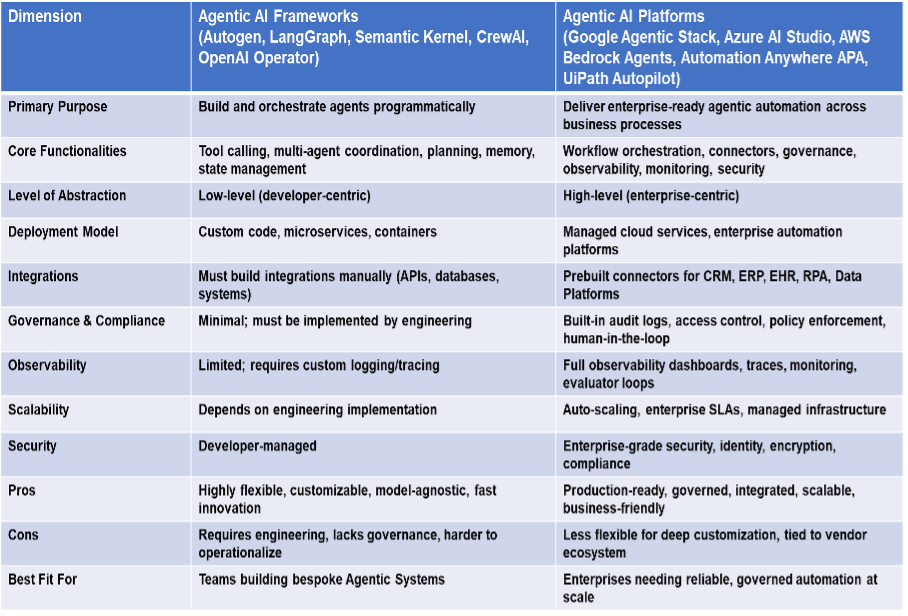
Agentic AI frameworks help to build Agents. Agentic AI platforms help to run, govern, and scale them safely across the Enterprise.
Vendors market both using the same words like: Agents, Orchestration, Tools, Workflows, Autonomy etc.
Conclusion
Agentic AI is rapidly moving from POC stage to Enterprise Scale Transformation. Agentic AI systems perceive context, reason through complexity, plan multi‑step actions, execute autonomously across systems, and continuously learn from outcomes, making them uniquely suited for high‑value operational workflows.
To adopt Agentic AI effectively, enterprises must first understand the fundamentals of agentic loops and develop a unified data and AI strategy that supports orchestration, tool integration, memory, and governance.
Enterprises should identify the highest value use cases where autonomous execution delivers measurable impact, such as reinventing workflows, reimagining user experiences, or accelerating product innovation.
Agentic AI platforms, whether open‑source or proprietary, must support standard-based integrations, enterprise data access, ML/DL Libraries, and robust governance frameworks.
Ultimately, Agentic AI is not a competitor to human capability but a strategic enabler augmenting expertise, amplifying productivity, and powering the next generation of intelligent, autonomous enterprise operations.
Acknowledgements
The authors would like to thank Tricon Solutions LLC and Gspann Technologies, Inc for giving the required time and support in many ways in bringing up this article.
About Authors
Dr. Gopala Krishna Behara is an Enterprise Architect at Tricon IT Solutions. He has around 28 years of IT experience. He can be reached at gopalakrishna.behara@gmail.com.
Narumanchi Sree Keerthi is a Senior Software Engineer at Gspann Technologies, Inc. She has around 5 years of IT experience. Reached at narumanchikeerthi@gmail.com.
Disclaimer
The views expressed in this article/presentation are those of authors and Tricon Solutions LLC and Gspann Technologies, Inc does not subscribe to the substance, veracity or truthfulness of the said opinion.